
Southern Nevada Wilderness Areas
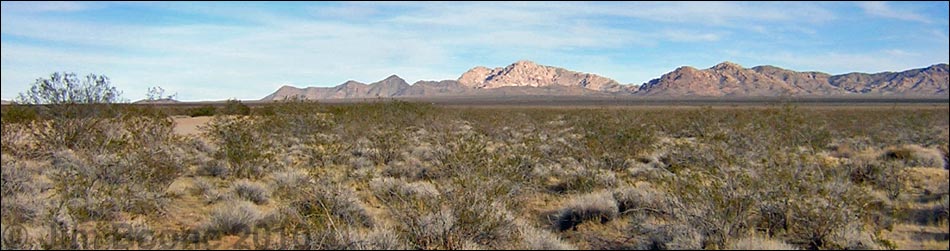
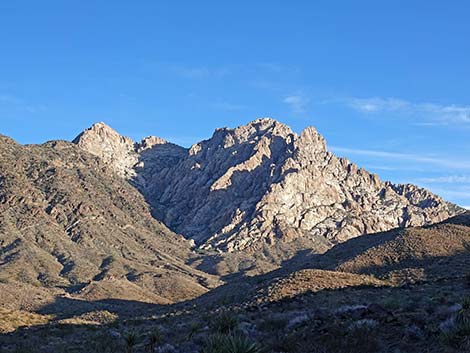 Northwest face of Spirit Mountain |
Overview Spirit Mountain, one of the larger (33,518 acres) wilderness areas in Clark County, includes a portion of the Newberry Mountains and mountainous country between there and Lake Mohave. The wilderness area is named for Spirit Mountain, an imposing monolith of white granite that is an important site for native peoples of the Mojave and Sonoran Deserts who consider it to be the center of their creation. East of Spirit Mountain, there is a jumble of metamorphic and granitic mountains and deep canyons that run to Lake Mohave. There are archeological sites in the area, but not on Spirit Mountain, proper. Springs and canyon potholes provide water for wildlife. Elevations range from 5,639 feet at Spirit Mountain to about 2,100 feet at the lake. |
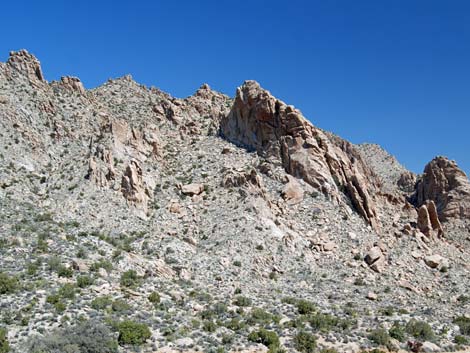 South face of Spirit Mountain |
The Spirit Mountain Wilderness Area is separated from the Nellis Wash Wilderness Area by a dirt road, and it is separated from the Bridge Canyon Wilderness Area by another dirt road. Combined, these three wilderness areas protect nearly 58,000 acres of designated wilderness. If you hike in wilderness areas, help protect them by learning about and reporting noxious and invasive weeds. Link to map of the wilderness area. Location The Spirit Mountain Wilderness Area is located about 70 air-miles south of Las Vegas, just north of Laughlin. |
 |
Boundaries The northern boundary of this kidney-shaped wilderness area is the Empire Wash Road (which is also the southern boundary of the Nellis Wash Wilderness Area), running from the Lake Mead National Recreation Area boundary on the west to a powerline corridor on the east. The eastern boundary follows the powerline corridor to Lake Mohave, then follows the lake south to Sacatone Wash. From there, it follows a dirt road (Nevada Telephone Cove Road) along the base of the mountains to Highway 163, which marks the southern boundary. The western boundary runs along Christmas Tree Pass Road to the pass, then runs north and angles slightly east to intersect the Lake Mead National Recreation Area boundary, which it follows back to the Empire Wash Road. |
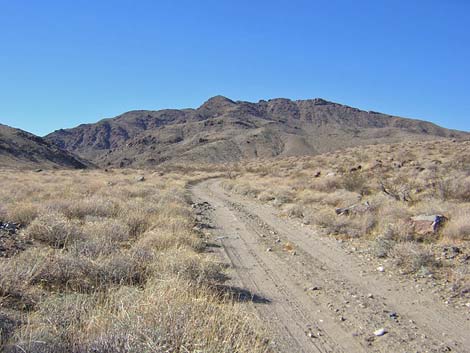
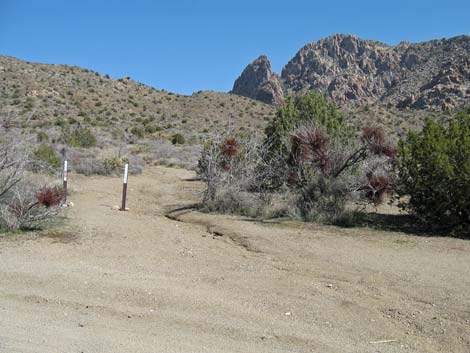 Traditional Spirit Mountain trailhead (view north) |
Access Access to the wilderness area is from Christmas Tree Pass Road, Highway 163, dirt roads on the north side of the wilderness area, from Nevada Telephone Cove Road and Lower Grapevine Canyon Road on the southeast side, and from Lake Mohave. Christmas Tree Pass Road is a graded dirt road that runs east from Highway 95 to Christmas Tree Pass, proper, then runs south to Highway 163. To the east of Christmas Tree Pass, proper, the road is steep and narrow for a couple of miles, possibly requiring a 4WD vehicle in a few places when wet. To access the west side of the wilderness area, drive south from Cal-Nev-Ari on Highway 95 for about 2.3 miles to Christmas Tree Pass Road (about 5.0 miles north of Highway 163). There is a small road sign for the turnoff; there is also a fairly large, covered information sign on the east side of the road that you can see from a long way off. |
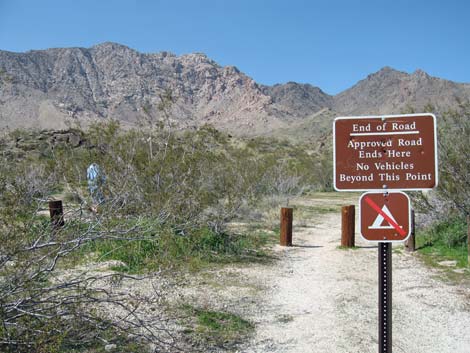 Trailhead southeast of Spirit Mountain (view NW) |
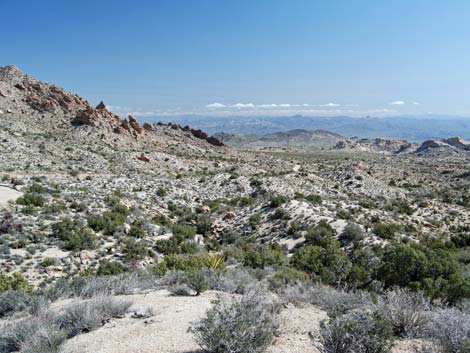
To access the south side of the wilderness area, drive east from Highway 95 on Highway 163 for about 12.9 miles to Christmas Tree Pass Road (a few miles west of Laughlin). There is a small road sign for the turnoff. Drive north on Christmas Tree Pass Road, which is the southwest boundary of the wilderness area. Terrain The area is located in the rugged Newberry Mountains, which rise to an elevation of about 5,600 feet. There are rugged granite peaks strewn with granite boulders and steep canyons throughout much of the area, although gentle bajadas and more rounded hills lie to the southeast of Spirit Mountain. |
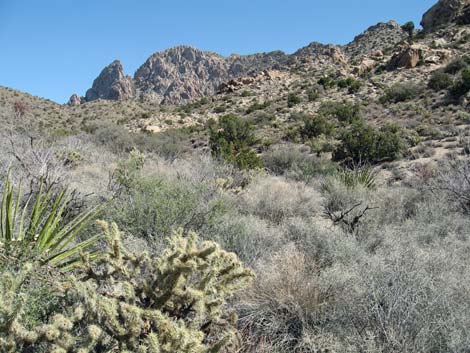 |
Habitat Type The habitat type at Christmas Tree Pass Pinyon-Juniper Woodland with California Juniper and blackbrush, and a bit of yucca, singleleaf pinyon, cholla, shrub live oak, and other species mixed in. The hillsides are rocky with rounded granitic outcrops. In the rocky canyons and washes at the base of Spirit Mountain, the vegetation is a juniper forest with a diverse flora (including paperbag bush, catclaw acacia, buckhorn cholla, a variety of composite shrubs, bitterbrush, yucca, nolina, buckwheat, shrub live oak, desert willow, pinyon pine, wax current, rabbitbrush, hedgehog cactus, Nevada jointfir, Mormon tea, and barrel cactus. At lower elevations, the vegetation is less diverse and more typical of Mojave Desert Scrub (creosote bush, white bursage, and other shrubs). In the washes, there are desert willow, cottonwood trees, grapevines, common reed, and lots of rabbitbrush. |
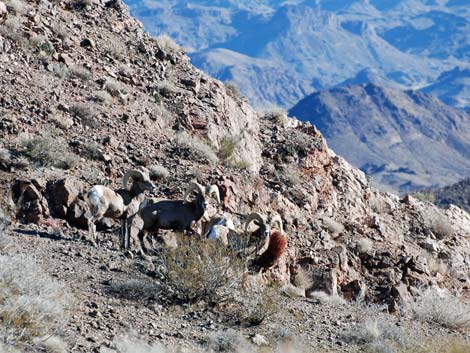 |
Wildlife Mammals include desert bighorn sheep, mule deer, pocket mice, Merriam's kangaroo rat, and other burrowing rodents, desert woodrats, bobcats, coyotes, desert cottontail, black-tailed jackrabbit, and bats. Reptiles include desert tortoise, chuckwallas, and several other species of lizards. Snakes include speckled and Mojave rattlesnakes, gopher snakes, long-nosed snakes, and several other species of snakes. Birds include Woodhouse's Scrub-Jay, Black-throated Sparrow, Phainopepla, Red-tailed Hawk, Sharp-shinned Hawk, Cactus Wren, Costa's Hummingbird, Crissal thrasher, and Bell's vireo. Sensitive species include the California leaf-nosed bat, Gila monster, Townsend's big-eared bat, and Yuma myotis. |
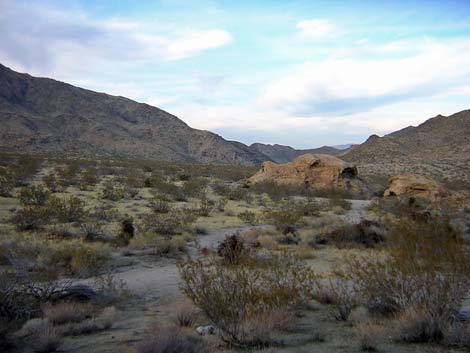 Wash southeast of Spirit Mountain |
Archaeology and Cultural Importance Spirit Mountain is important to the native peoples of the Mojave and Sonoran Deserts (the 'Pai tribal groups such as the Wala 'Pai, Yavi 'Pai, and Havasu 'Pai) as the center of their creation. The Hopi and Chemehuevi also consider this an important site, but not their spiritual birthplace. There are no known secular archeological sites within the area (e.g., villages, hunting blinds, etc.). It is thought that because traditional practitioners limited secular activities on the mountain, the absence of artifacts highlights the importance of Spirit Mountain and suggests that the area was used exclusively for religious purposes. The Spirit Mountain area has been designated a Traditional Cultural Property by the BLM and the National Park Service, and it is listed on the National Register of Historic Places. Alongside federal land managers, Spirit Mountain is monitored by the Aha'Mahv group from Fort Mojave. |
 |
Geology The northern part of the wilderness area is composed of granites and older metamorphic rocks. The granites date from about 1.4 billion years ago and the metamorphic rocks are composed of gneiss and schists that date from about 1.7 billion years ago. These rock types are separated by faults. The southern part of the area is composed of coarsely granular (granitic) intrusive rocks, which are separated from the northern rocks by more faults. |
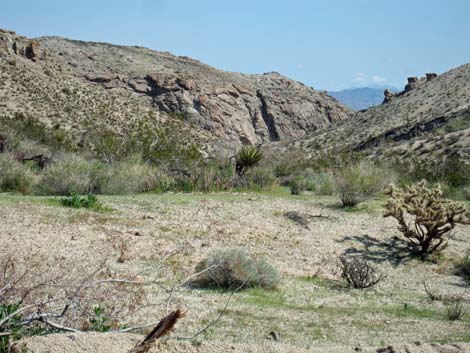 Pipe Spring area |
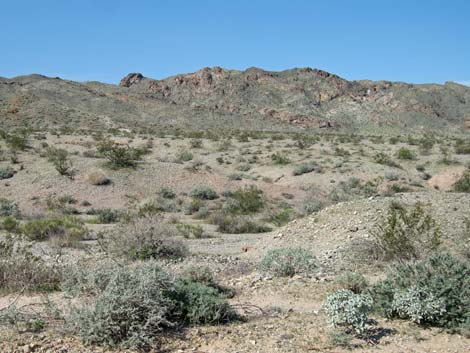 Southeast edge of wilderness |
Note: All distances, elevations, and other facts are approximate.
 ; Last updated 240331
| Wilderness Areas | Hiking | Guide Services | Glossary | Copyright, Conditions, Disclaimer | Home |