
Gopher Snake (Pituophis catenifer)
Snakes Around Las Vegas, Wildlife Around Las Vegas
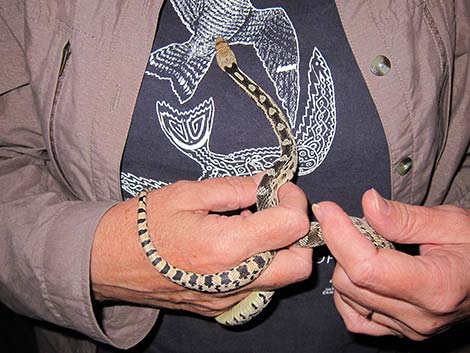 Narrow head, blotched dorsal pattern |
General Description: Gopher snakes are long, fairly heavy-bodied snakes with a small head. The dorsal color is straw with large dark blotches down the center of the back and smaller, more irregular blotches on the sides. There is a dark line across the forehead between the eyes Taxonomy: Colubrid Snakes Family (Colubridae). Formerly Pituophis melanoleucus, but this name now refers only to the Pinesnake of the southeastern US. Technical Description: Body 4 to 5 feet long (72 inches); moderately heavy. Dorsal color straw with large dark blotches down the center of the back and smaller, more irregular blotches on the sides. Head with a dark line extending across the forehead from eye to eye and down to the upper lip. |
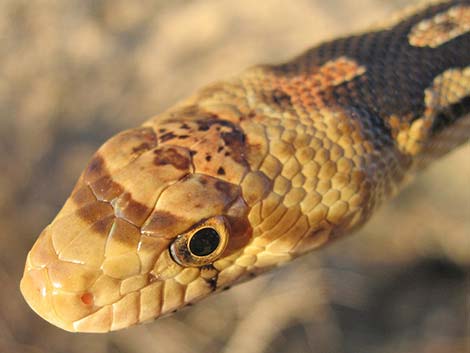 Note line across forehead between the eyes |
Diet: Mostly small rodents (mice, rats, gophers, and ground squirrels), also rabbits, birds (quail, ducks, and bird eggs), and lizards. Forages in mammal burrows, on the ground, and in shrubs. Prey killed by constriction. Habitat: Wide-ranging. Found in all habitat types up to about 7,000 ft elevation, generally absent only from densely forested areas. Range: This wide-ranging species occurs throughout the United States, southern Canada, and northern Mexico. This subspecies ranges from southern British Columbia south through eastern Washington to southeastern California, and then eastward through Idaho, Utah, western Wyoming, western Colorado, northern Arizona, and northwestern New Mexico. |
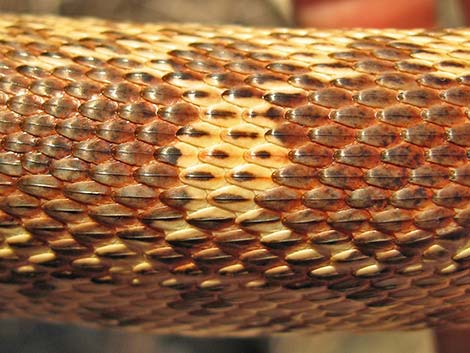 Scaled usually keeled |
Breeding: Mates in spring. Lays one or two clutches of 3 to 18 eggs below ground in rock piles, mammal burrows, and loose soil in early summer. Sometimes nests communally. Hatchlings emerge in fall. Similar Species: No other species in southern Nevada is straw-colored with large dark blotches down the center of the back. Comments: The color pattern and behavior of gopher snakes mimic those of rattlesnakes; they hiss, flatten their head to make it look more broad and triangular, and vibrate their tail. |
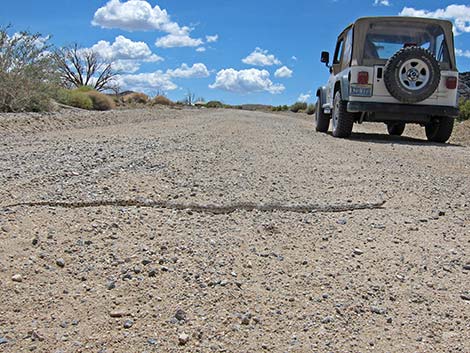 Watch for Gopher Snakes crossing roads |
While most snakes come out at night, Gopher Snakes come out during the day, so people are likely to see them on roads during the day. Most grow to about 4 feet long, but I caught one that was over 7 feet long! Gopher snakes try to imitate rattlesnakes. Note that the general colors and pattern are similar to rattlesnakes. Also like rattlesnakes, they often stand their ground rather than slither off as fast as possible. Sometimes they will flatten their head to make their jaws flare out, giving them the triangular-shaped head of a rattlesnake, and they will even assume the strike position of a rattlesnake and shake their tail. Best of all, gopher snakes can hiss loudly - and if you listen carefully, you will realize that the hiss sounds like the buzz of a rattlesnake rattle! Gophers seem to have personalities ranging from calm to frenzied. Calm gophers can be handled easily, but agitated snakes will bite. The bite is "harmless," but some of their teeth are likely to break off (they grow back, but it can't be good for them), and the bite can be painful or even get infected. |
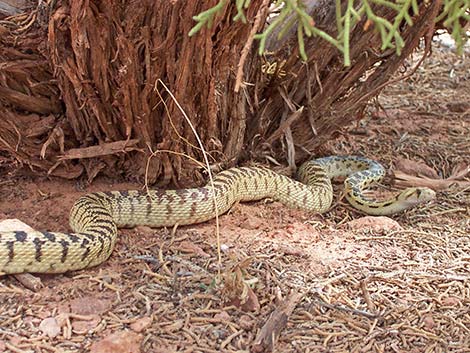 Gopher snake under a juniper tree |
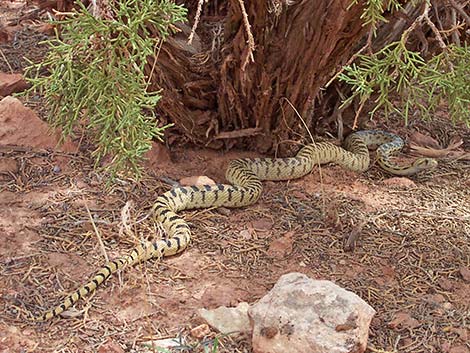 Gopher snake under a juniper tree |
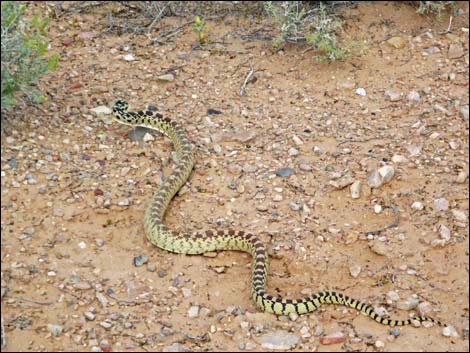 Gopher Snake in Gold Butte National Monument |
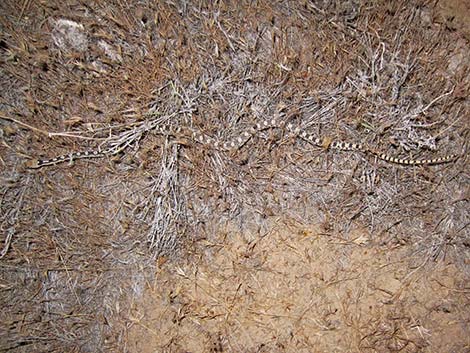 Gopher Snake in low bushes |
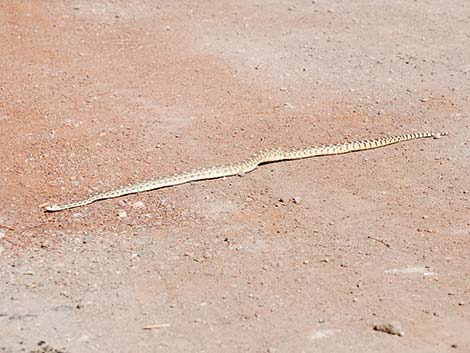 Gopher Snake crossing a road |
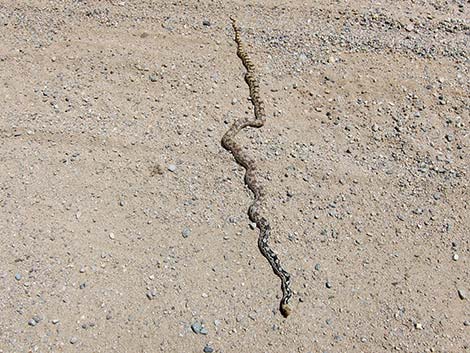 Gopher Snake crossing a road |
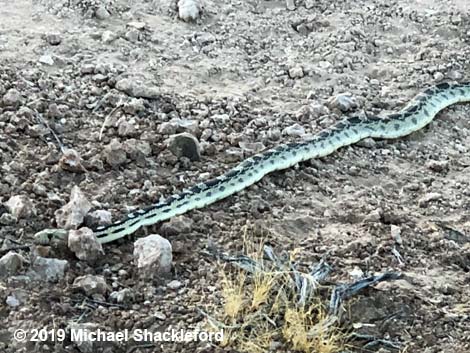 Gopher Snake with unusual greenish coloring |
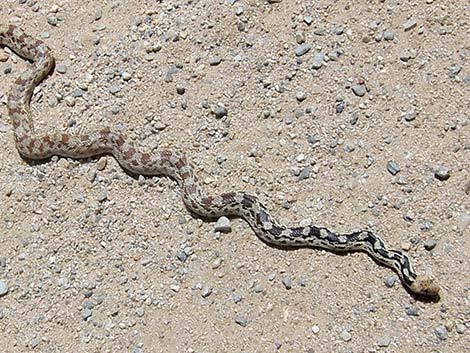 Unusual dark anterior color and pale posterior color |
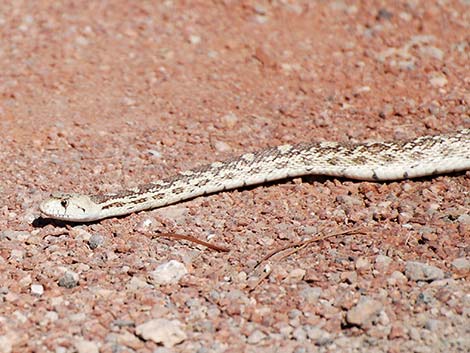 Gopher Snake crossing a road |
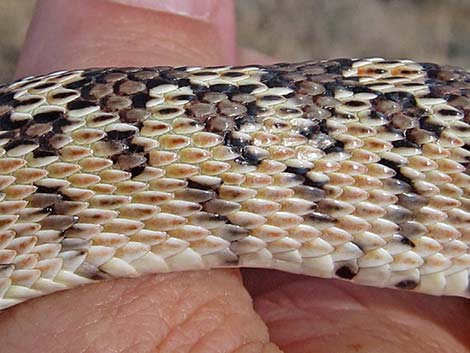 Scales are not always keeled (northern Nevada) |
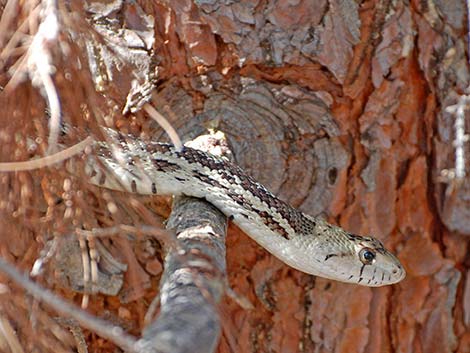 Gopher Snake in a pine tree, perhaps looking for bird eggs |
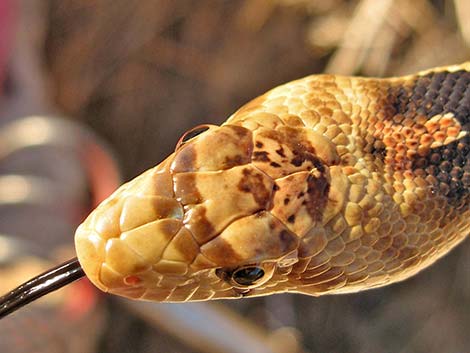 Snakes "smell" the air with their tongue |
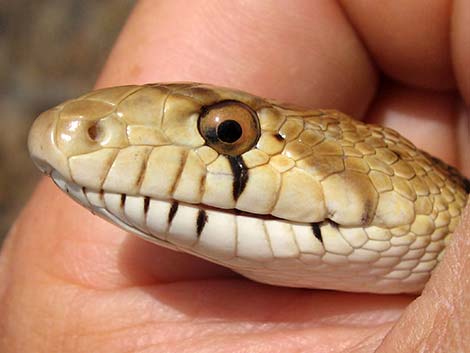 Dark marks on jaws look like long, menacing teeth |
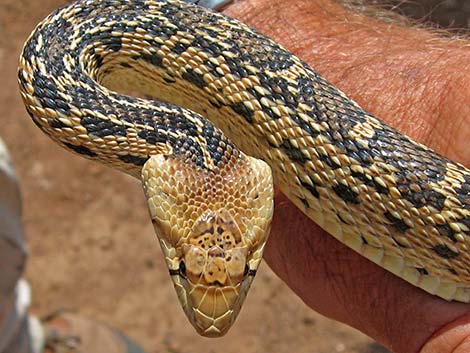 Alarmed snake flattens head, spreads jaws to resemble a rattlesnake |
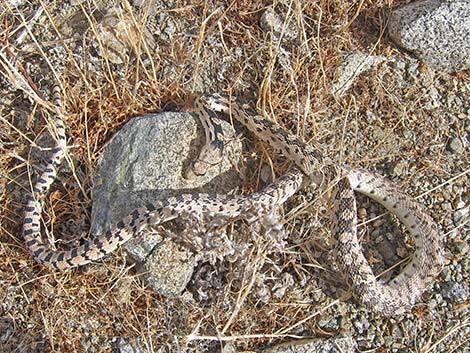 Pinkish coloration in northern Nevada |
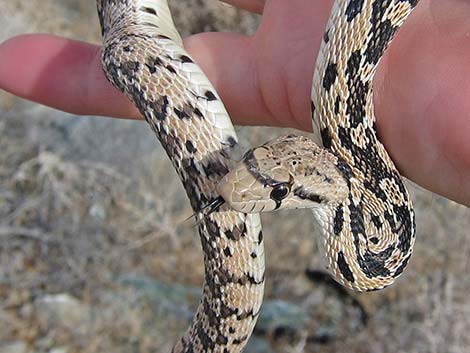 Pinkish coloration in northern Nevada |
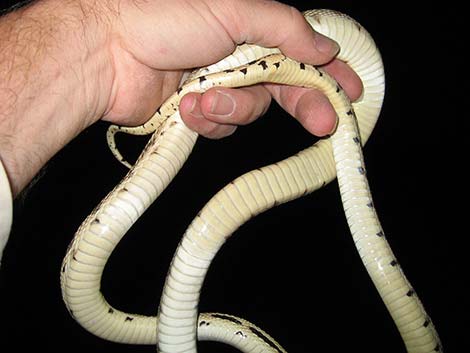 |
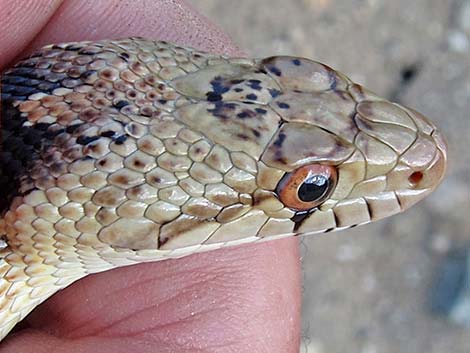 |
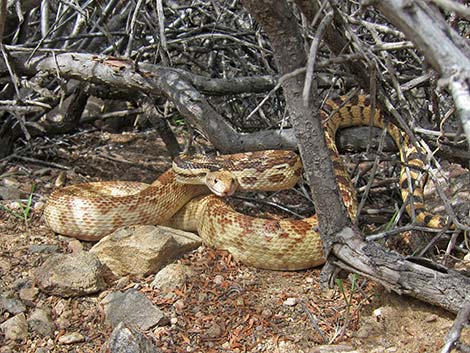 This is one unhappy snake! |
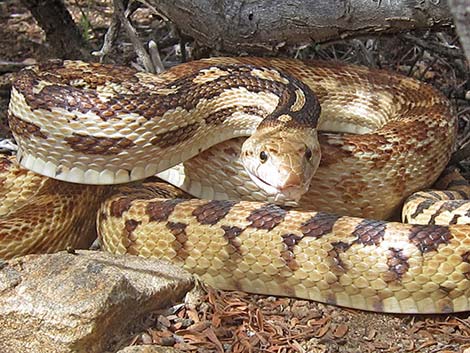 Unhappy snake! |
 Jim with a big, friendly gopher snake |
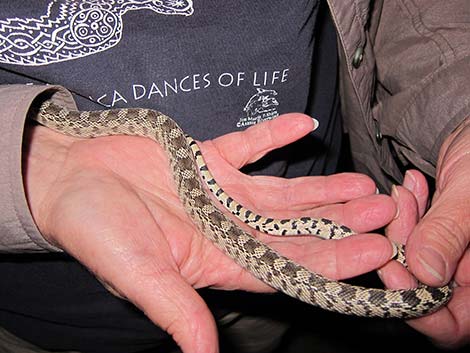 For all the tough bluff and bluster, gopher snakes are quite friendly |
Note: All distances, elevations, and other facts are approximate.
 ; Last updated 221214
| Snakes Around Las Vegas | Wildlife Around Las Vegas | Glossary | Copyright, Conditions, Disclaimer | Home |