
Mammals Around Las Vegas, Wildlife Around Las Vegas
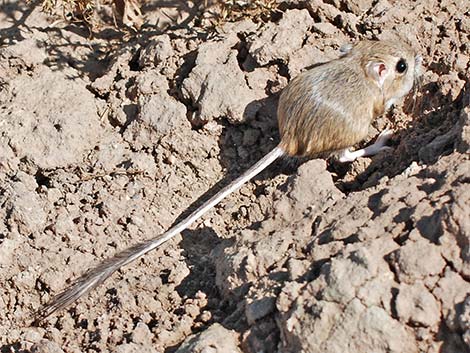 |
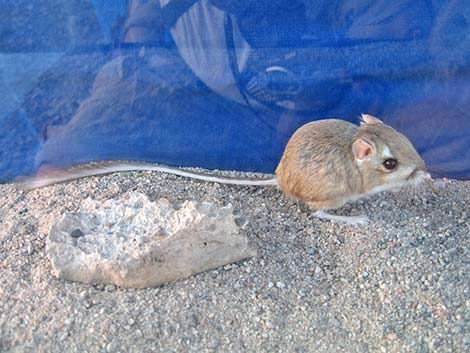
General: Merriam's Kangaroo Rats (Dipodomys merriami) are recognized by their kangaroo-like appearance: they have large hind legs and feet, small front legs and feet, long tufted tails, and they hop on their hind legs like Australian kangaroos. Merriam's is the smallest kangaroo rat species around Las Vegas. Like real kangaroos, kangaroo rats also have a pouch, or rather, two pouches for carrying things. Kangaroo rats have external, fur-lined cheek pouches that they use to carry seeds and other food items into their burrow for storage. Most animals carry food in their mouth (e.g., dogs and cats) or in their cheeks (squirrels), but kangaroo rats actually have an extra pouch on the outside of their cheeks. Merriam's Kangaroo Rats are very common in some parts of the desert. In desert flats, almost all of the "snake" holes around the base of bushes are kangaroo rat burrows. They are solitary, and a single individual digs a burrow with a nest chamber and many entrances. |
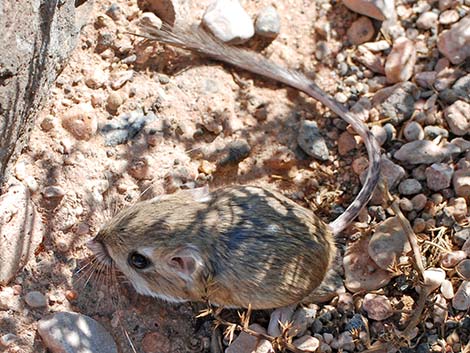 |
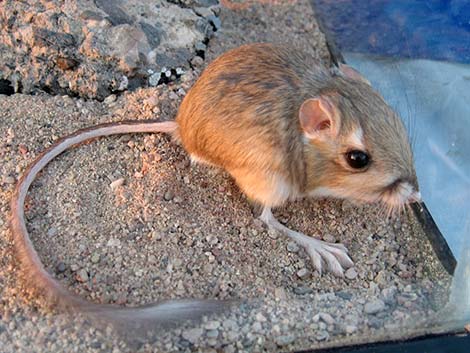
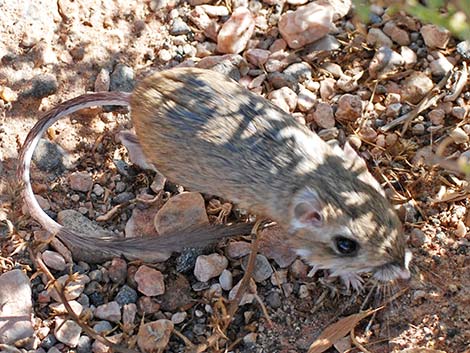
Description: Merriam's Kangaroo Rats are small for kangaroo rats (head and body: 3-4 inches; tail: 5-6 inches; total length to about 10 inches). Color pale yellowish brown above, white below. Tail tuft dark. Hind foot with 4 toes; toes are clearly visible through the hairs. Tail dark with light stripes on the sides; white stripes wider than dark stripes. Around Las Vegas, this is the small, 4-toed k-rat. Taxonomy: Family: Rodentia (Gnawing animals such as mice, rats, squirrels, and beaver). Diet: Feeds primarily on dry seeds; also eats some green vegetation when available. Does not require free water; can metabolize water from a diet of dry seeds. Habitat: Found in great numbers on desert flats and bajadas in the Lower Sonoran (Creosote-Bursage Flats) and Upper Sonoran (Mojave Desert Scrub) life zones, and fades out in the Upper Sonoran (Pinyon-Juniper Woodland) life zone. |
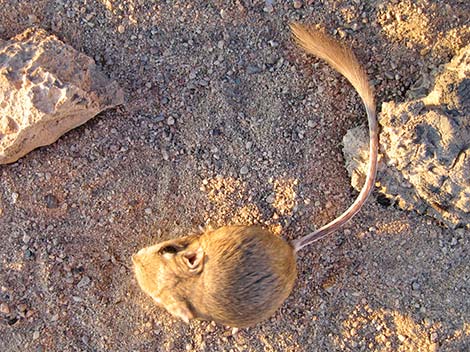 |
Range: Northwestern Nevada and southeastern California, south and east into northern Mexico. In Nevada, this species is found in lower-elevation desert areas into the northwest corner of the state, and it is widespread and abundant around Las Vegas in the appropriate habitat. Breeding: Produce several litters of 1-5 pups per year; born January to August. Comments: Nocturnal and solitary. When excited, kicks sand and drums the ground with its hind feet. Predation: Everything eats kangaroo rats. Owls are a primary predator, and snakes, kit foxes, coyotes, and bobcats take many. When startled, kangaroo rats often jump straight up into the air some 1-2 feet, then take off flying on two hind feet and a tail. The tail is held out behind for balance and the forelegs are tucked against the chest. |
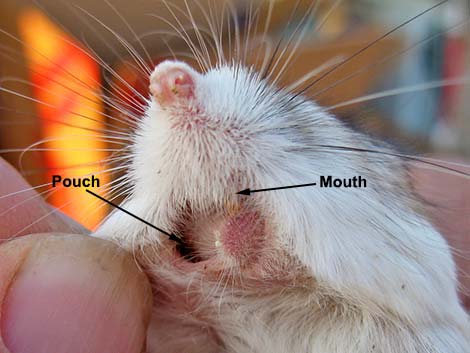 External, fur-lined cheek pouch; mouth is to the right |
Kangaroo rat burrow entrances: While many entrance holes might be seen, most probably go into only 3 or 4 burrows. K-rat burrows almost always dip into the earth at a shallow angle (never steep), which facilitates dashing into the burrow at a high rate of speed when a kit fox or great horned owl is on their tail. The tunnel usually is round with a flat bottom, and the excavated dirt is pushed out and scattered in one direction. Inside the burrow, k-rats often pile up sand to block the burrow entrance during the day. This keeps humid air inside the burrow (helps with water retention) and hopefully keeps snakes outside! |
 |
 |
 |
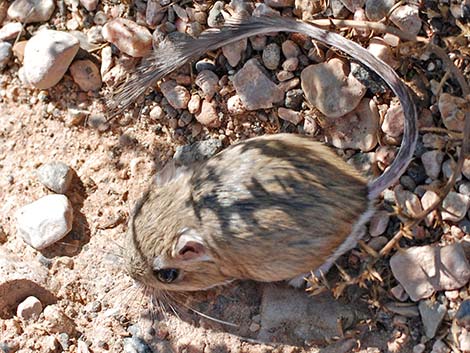 |
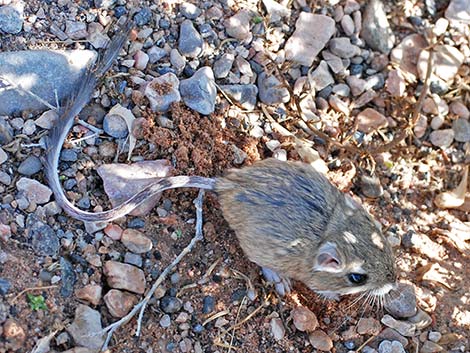 Merriam's Kangaroo Rat |
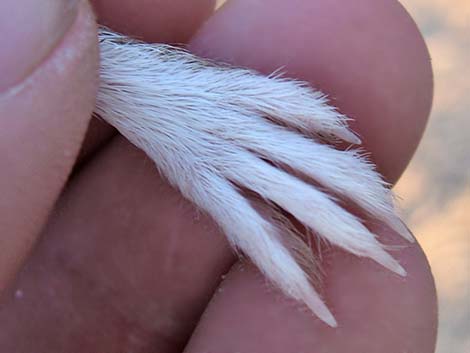 Four toes on hind foot; not much fur |
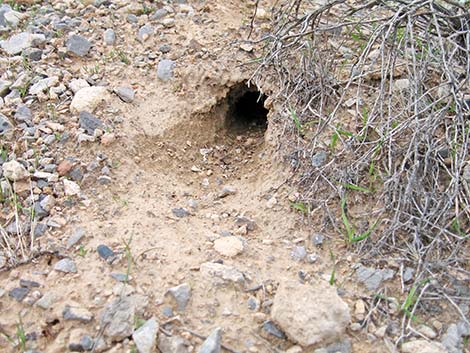 Kangaroo rat burrow; notice the small size and flat entrance |
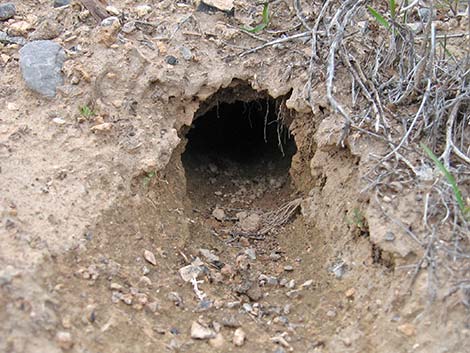 K-rat burrow; notice the round tube with flat floor |
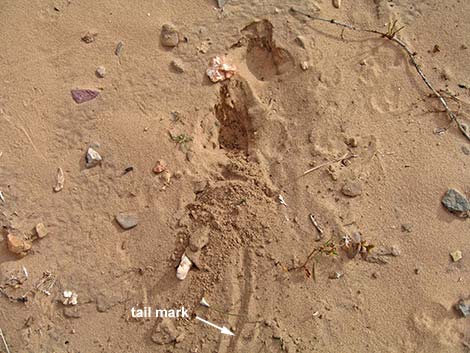 K-rat seed cache hole; notice the tail mark |
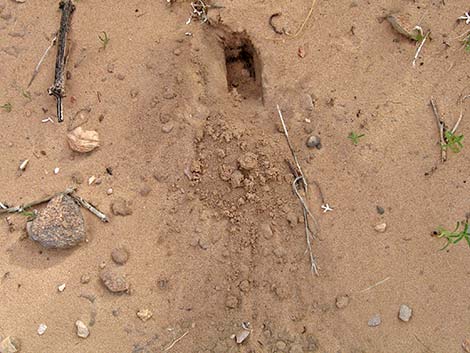 K-rat seed cache hole; notice narrow trench with steep sides |
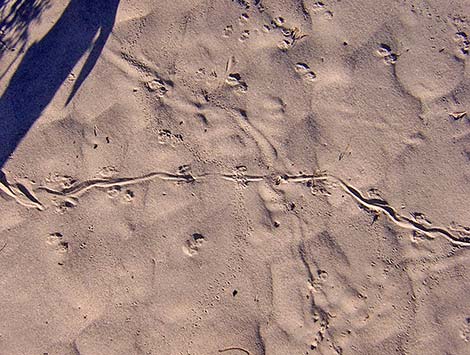 Tracks in the sand left by a slow-moving kangaroo rat |
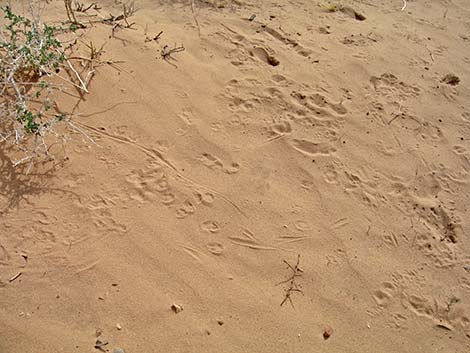 K-rat foot prints and tail marks in red sand |
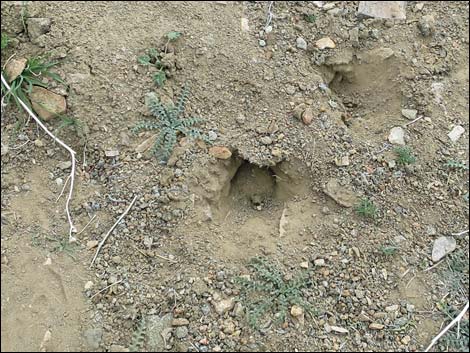 Entrance blocked from the inside |
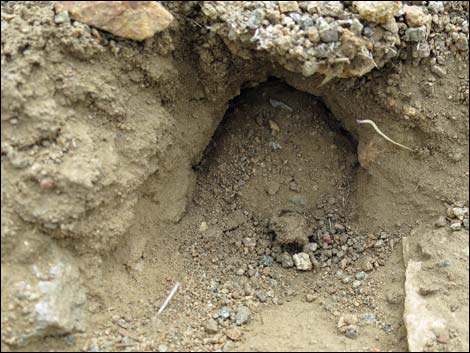 Entrance blocked from the inside (zoom) |
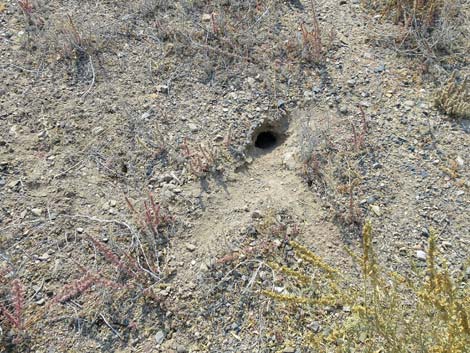 Small entrance to a Merriam's Kangaroo Rat burrow |
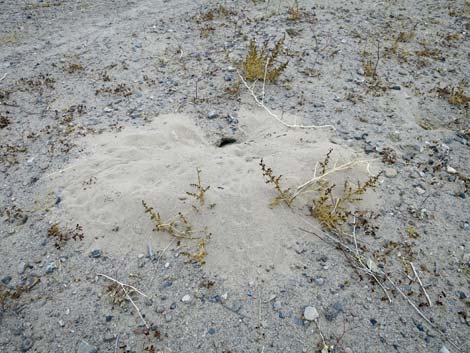 Merriam's Kangaroo Rat burrow in sandy soil |
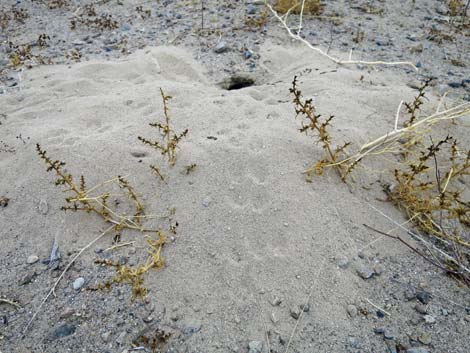 Merriam's Kangaroo Rat; note paired tracks in sandy soil |
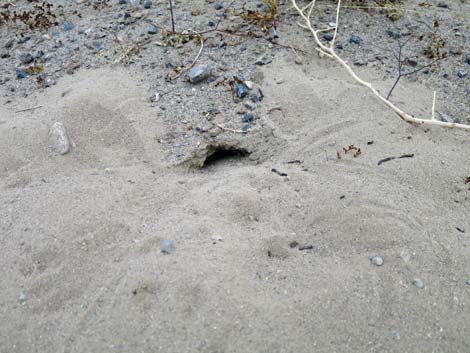 Merriam's Kangaroo Rat burrow plugged from the inside |
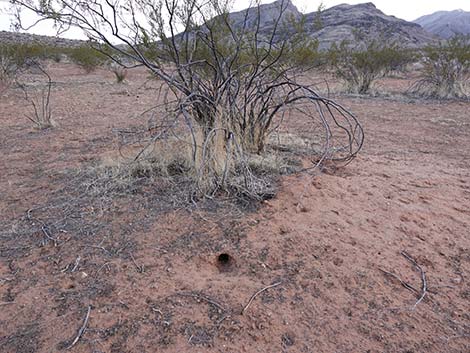 Merriam's create small, 2-inch diameter, burrow entrances |
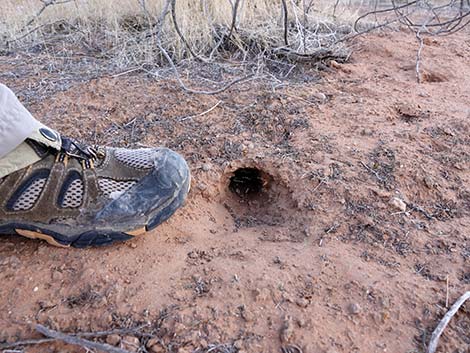 Merriam's create small, 2-inch diameter, burrow entrances |
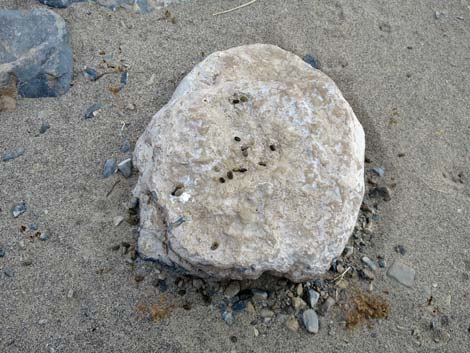 Merriam's Kangaroo Rat scat on and around a flat stone |
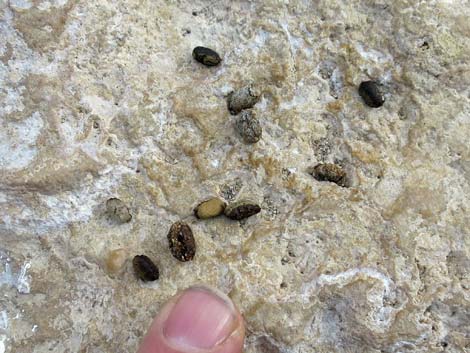 Merriam's Kangaroo Rat scat on a flat stone |
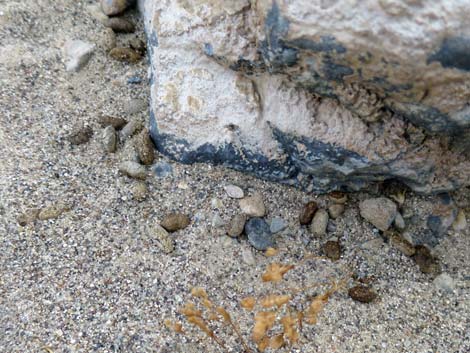 Merriam's Kangaroo Rat scat by a flat stone |
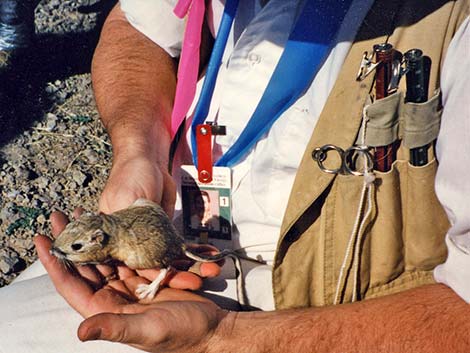 Catching kangaroo rats at Yucca Mountain |
Note: All distances, elevations, and other facts are approximate.
 ; Last updated 240226
| Mammals Around Las Vegas | Wildlife Around Las Vegas | Glossary | Copyright, Conditions, Disclaimer | Home |