
Hiking Around Las Vegas
| South Rim Hikes | North Rim Hikes | |
| Points of Interest
|
 |
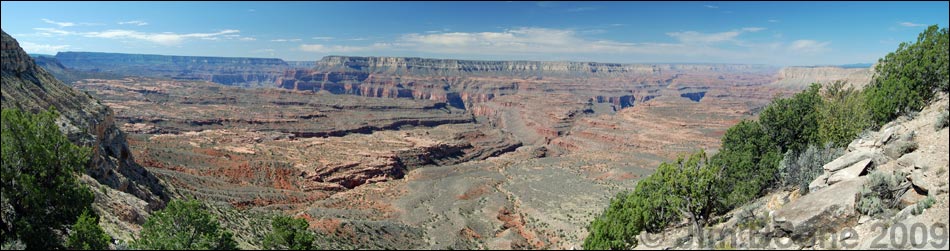
Grand Canyon National Park, administered by the U.S. National Park Service, is located in north-central Arizona (map), due east of Las Vegas. The primary feature of the park is the 5,000-foot-deep canyon cut by the Colorado River and the scenic vistas across the canyon. There are two sides to every canyon: the South Rim of the Grand Canyon is about 5.5 hours southeast of Las Vegas (via Kingman, Arizona), while the North Rim is about 6.5 hours northeast of Las Vegas (via St. George, Utah). For detailed information, see my Grand Canyon Area Overview Page. Activities at the Grand Canyon primarily are orientated around sightseeing and day-hiking along the rims, although there is also backpacking into the canyon, picnicking, mule riding, biking, car camping, and lodging. The two rims are located high on the Colorado Plateau. The elevation of the South Rim at Mather Point is 7,120 feet, while the elevation of the North Rim at Bright Angel Point is 8,250 feet. These two points are separated by about 10 air-miles and the Colorado River, which lies some 4,600 and 5,700 feet below the two rims, respectively (2,550 feet elevation at Phantom Ranch). |
The river is in the low-elevation desert zone, the South Rim is in the mid-elevation pinyon-juniper, yellow-pine forest zone, and the North Rim is in the higher-elevation yellow-pine, pine-fir, spruce forest zone. The great range of elevations makes for a mix of habitats, providing for considerable floral and faunal diversity.
The South Rim is relatively high, so temperatures are cool compared to Las Vegas, and daytime summer temperatures range in the 50s to 80s, while winter temperatures range in the 20s to 50s. The North Rim is even higher, and summer temperatures there are about 10 degrees cooler than on the South Rim. The North Rim is closed by snow during winter (about mid-October through mid-May). The bottom of the canyon is hot like Las Vegas, with summer temperatures exceeding 110 degrees. Because of the high temperatures in the inner canyon, hiking is best during the fall, winter, and spring (e.g., October to May). During July and August, afternoon thunderstorms are common, creating flash floods and lightning hazards.
Because of the summer crowds on the South Rim, the Park Service established a shuttle bus system. The park entrance fees cover the shuttle bus, so after you get in the park, the bus is free. The Hermits Rest Road in the western-most portion of the South Rim is closed to private vehicles (with some exceptions) when the shuttle bus is running, but all of the other park roads are open to private vehicles. Buses run throughout the South Rim Village area, so people can park in the village or the campground and ride the bus throughout the area. Details on the shuttle bus system are provided below.
On the South Rim, there are a variety of concessions inside the park. Grand Canyon Village is a regular city with all of the usual urban services (e.g., grocery store, restaurants, lodging, post office, and bank) except gasoline. Most concessions are open during regular business hours or longer. Outside the park, the town of Tusayan provides gasoline and just about everything else.
On the North Rim, services inside the park are limited. This is rural country, so bring what you need. There is a small market, a lodge with a restaurant, a coin laundry, and showers, but no gasoline inside the park. Most concessions are open during regular business hours or longer. Outside the park, the town of Jacobs Lake provides limited services (e.g., gasoline, lodge, campground), and the Kaibab Lodge just outside the park provides some basic services and gasoline.
Hiking in the Grand Canyon carries a challenge that Nevada hikers rarely face: hiking permits that can be hard to get. Because the area is so popular, backcountry use is highly regulated. Permits are required for all overnight travel, and most permit reservations are booked solid 4 months ahead of time, but some walk-up permits may be available. Permits are not required for the day-hikes. More information on hiking permits is provided below.
If you don't want to hassle permits, or if you fly into the area or otherwise don't arrive with hiking or backpacking gear, consider contacting Four Seasons Outfitters and Guides out of Flagstaff, Arizona. They provide rental gear, guided hikes, and other hiker services. Their prices are reasonable, and the guides are first rate (experienced, knowledgeable, strong as mules, they do everything, and they are good company in camp).
For More Information on Getting to Grand Canyon National Park, Hours of Operation, the Shuttle Bus System, Entrance Fees, Car Camping, Hiking Permits, Precautions, Rules and Regulations, and Links to More Information, visit the Grand Canyon National Park Overview Page.
Happy Hiking! All distances, elevations, and other facts are approximate.
 ; Last updated 240326
| Hiking Around Las Vegas | Glossary | Copyright, Conditions, Disclaimer | Home |