
Hiking Around Las Vegas
 |
Zion National Park Hikes | |
|
||
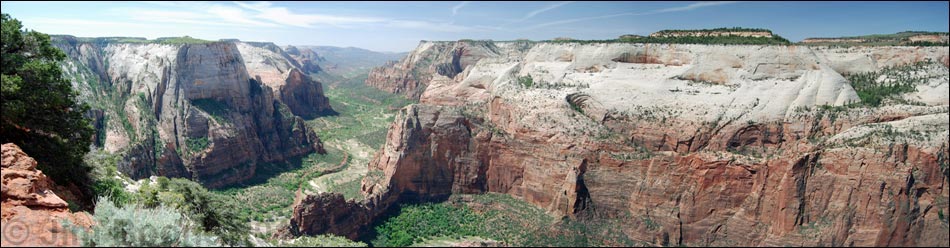
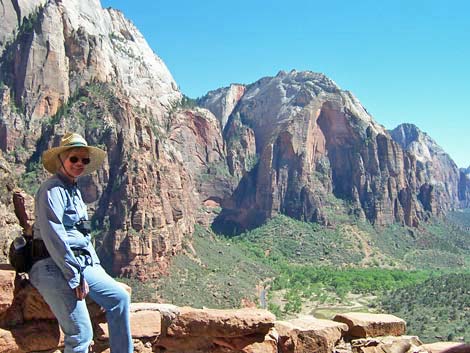
Zion National Park, administered by the U.S. National Park Service, is located in southwestern Utah (map), about 3-hours northeast of Las Vegas. The primary feature of the park is Zion Canyon and the sheer sandstone cliffs that tower 2,000 to 3,000 feet above the floor of the canyon. Zion Canyon, however, only makes up a small percentage of the park area, and the other parts of the park are wild lands that offer wonderful hiking opportunities. There are also towering sandstone cliffs and deep valleys in the northwestern portion of the park (the Kolob Region), but not on the same scale as those in Zion Canyon. Higher-elevation forests and sculpted sandstone canyons and mesa tops can be found in the eastern portion of the park. Activities in Zion National Park primarily are orientated around sightseeing and day hiking in Zion Canyon, although there is also picnicking, swimming in the river, horseback riding, biking, backpacking, and car camping. Zion is located at the junction of the Colorado Plateau, the Great Basin, and the Mojave Desert, providing for a mix of habitats and life zones and making for an unusually diverse floral and faunal community. Because of the crowded roads and parking areas, the Park Service established a shuttle bus system to eliminate traffic and restore tranquility in upper Zion Canyon. As a result, travel by private vehicles to the upper end of Zion Canyon is prohibited when the shuttle is running (April through November). The park entrance fees cover the shuttle bus, so after you get in the park, the bus is "free." The main highway across the park (Highway 9) is always open to private vehicles (with some restrictions on oversized vehicles), and all other park roads are open. More details are provided below. The bottom of Zion Canyon is relatively low (about 4,000 feet), and temperatures often exceed 100 degrees during summer (but that is cooler than Las Vegas!). It snows during winter, especially in the high country, so hiking in Zion generally is best during the spring and fall (e.g., September to November, and March through May). During July and August, afternoon thunderstorms are common and create two problems: many of the trails are in the bottom of narrow canyons that are subject to flash floods, and many of the other trails are on ridgelines that are subject to lightning. Hiking in Zion carries a challenge that Nevada hikers rarely face: hiking permits. Because the area is so popular, backcountry use is highly regulated. Permits are required for overnight travel, climbing bivouacs, longer day trips, and trips requiring descending gear. Permits are issued at the Zion Canyon and Kolob visitor centers. Day-hiking permits are issued the day before the hike, and backpacking permits are issued up to three days before the trip. Permits are not required for the short hikes in Zion Canyon, including short hikes up the Zion Narrows. More details on hiking permits are provided below. For More Information on Getting to Zion National Park, Hours of Operation, Entrance Fees, the Shuttle Bus System, Car Camping, Hiking Permits, Precautions, Rules and Regulations, and Links to More Information, visit the Zion National Park Area Overview Page. |
Happy Hiking! All distances, elevations, and other facts are approximate.
 ; Last updated 240330
| Hiking Around Las Vegas | Birding Around Las Vegas | Glossary | Copyright, Conditions, Disclaimer | Home |