
Mammals Around Las Vegas, Wildlife Around Las Vegas
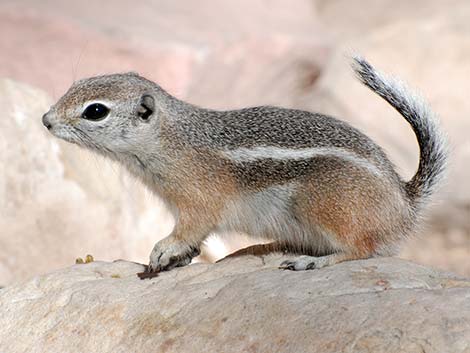 White eye-ring, but no stripes on face |
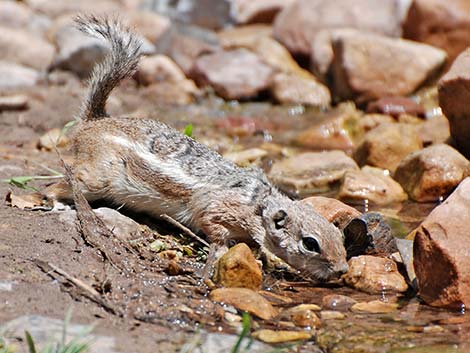
General Information: White-tailed Antelope Squirrels (Ammospermophilus leucurus) are the small ground squirrels often seen running around the desert on hot days. They have a dark back with a white stripe on the side, light cheeks, and a white eyering. The legs usually have some reddish, and the belly is white. The underside of the tail is white. Antelope Squirrels often hold their tail up over their back as a sunshade. The name "white-tailed" refers to the white on the underside of the tail, a characteristic that can be used to separate them from Harris' Antelope Squirrel. White-tails, however, live west of the Colorado River, while Harris' live east of the Colorado River. If you visit Hoover Dam, you can see White-tails begging for food on the Nevada side, and Harris' begging for food on the Arizona side. Antelope Squirrels are often mistaken for chipmunks, but Antelope Squirrels have white or light on the side of the face, while chipmunks have black and white stripes on the side of the face. Also, Antelope Squirrels live in lower-elevation desert areas (Creosote-Bursage Flats and Mojave Desert Scrub habitat types), while chipmunks live higher in the mountains (Pinyon-Juniper Woodlands to Alpine Tundra habitat types). |
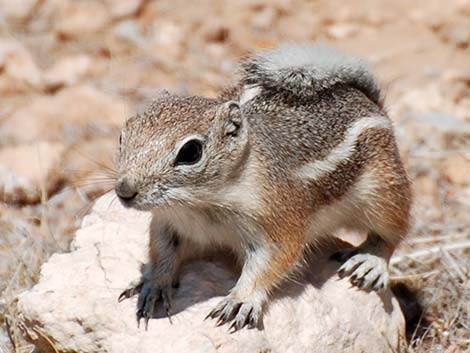 Antelope Squirrels live in the desert, not mountains |
White-tailed Antelope Squirrels dig burrows and are responsible for some of the holes under bushes and rocks seen in the desert. Their entrance holes tend to be about 3-inches in diameter, larger in diameter than those of the more common kangaroo rats. They also tend to make large burrow complexes with many entrances and often a 10-ft diameter are of raised dirt, the results of years of digging tunnels and pushing the spoils material to the surface. Taxonomy: Order: Rodentia (Gnawing animals); Family: Sciuridae (Squirrels). Technical Description: Sexes alike. Head and body length to about 6 inches; tail to about 3 inches. Weight to about 5-1/2 oz. Body color reddish-gray. Sides of the body with 2 black stripes separated by one white stripe. Upper surface of tail dark; lower surface white. Usually holds tail over the back, exposing the white underside. Skull with 22 teeth. Females 10 mammae. |
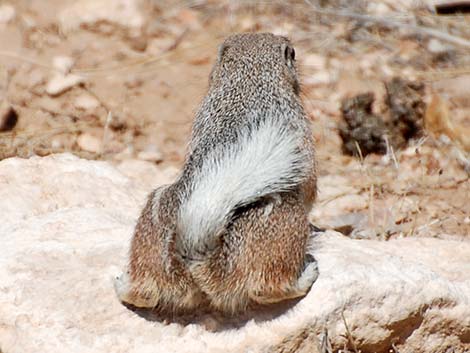 Underside of tail is white |
Breeding: Breed during spring and early summer. Litters large (5-14). Young leave their underground nest when 6-7 weeks old, but stay with their mother during the first year. Diet: Vegetation and bugs. Range: Southwestern Deserts north and west of the Colorado River. Another species (Harris') lives across the river in Arizona. Comments: Active during the day all year, even during the heat of summer, these squirrels can survive with body temperatures as high as 108 °F. They use their white tail as a sunshade, and they often can be seen laying with their belly pushed flat against a shady (cool) patch of ground to cool down. For More Information: On-line Animal Diversity Web. |
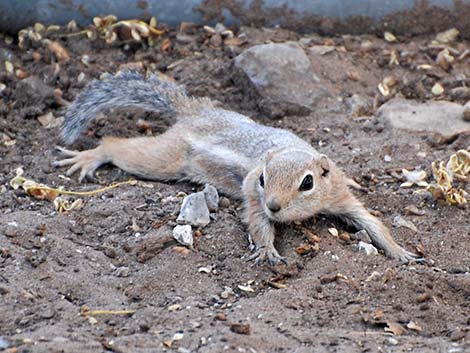 |
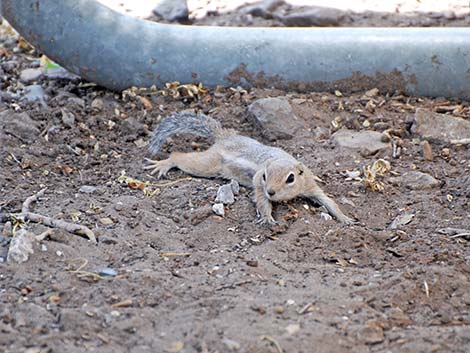
Cooling off by lying stretched out in the shade. Active during the day all year, even during the heat of summer, these squirrels can survive body temperatures as high as 108 degrees F. They use their white tail as a sunshade, and they often can be seen laying with their belly pushed flat against a shady (cool) patch of ground to cool down. |
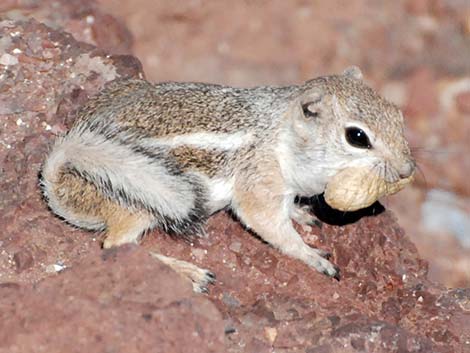 |
White-tailed Antelope Squirrel with a peanut. Note that the underside of the tail is entirely white. Antelope Squirrels certainly like peanuts and other free food, but feeding the wildlife is not a good idea for several reasons. It makes them dependent on people, and if people stop feeding them, the squirrels starve. It artificially raises the population size, which encourages the spread of diseases, so they get sick and die even if people keep feeding them. Also, wild animals can become "tame," which leads to finger bites and possible transmission of diseases to humans. Increasing the density of animals also increases the density of their parasites, and things like fleas can get on the people feeding them, possibly transmitting flea-borne diseases. All in all, it is better to let animals find their own food and keep everything in natures balance. |
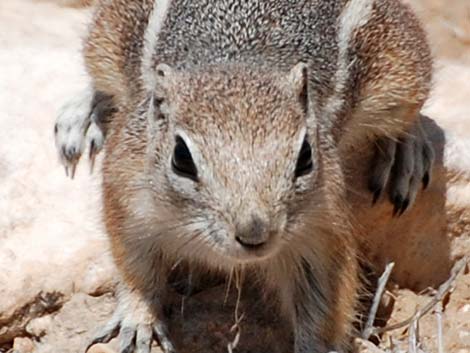 |
If you were a tasty seed or a juicy bug, this might be the last face you'd ever see. |
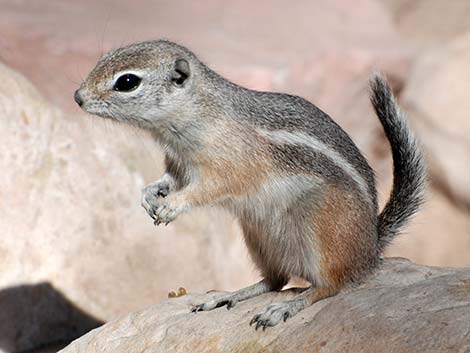 White eye-ring, but no stripes on face |
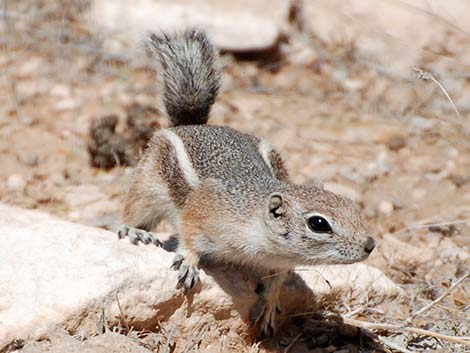 Top of tail is dark |
 |
 |
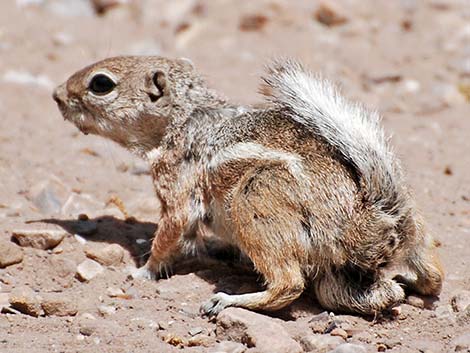 Adult male during breeding season |
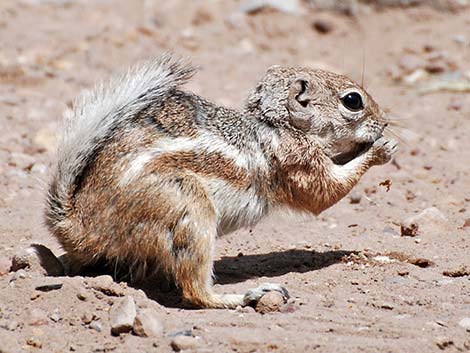 Typical feeding position with tail held over the back |
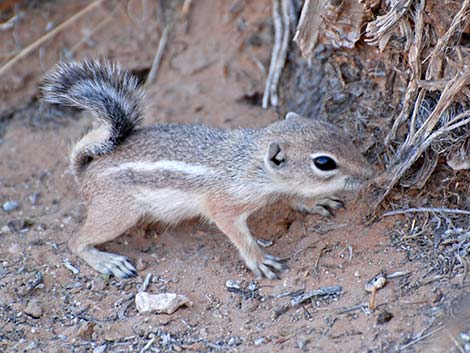 This juvenile squirrel seemed to be out exploring the world for the first time. It sniffed everything and tasted many non-food items. |
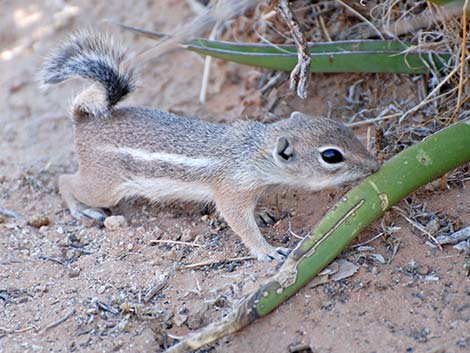 Tasting a Mojave Yucca leaf... |
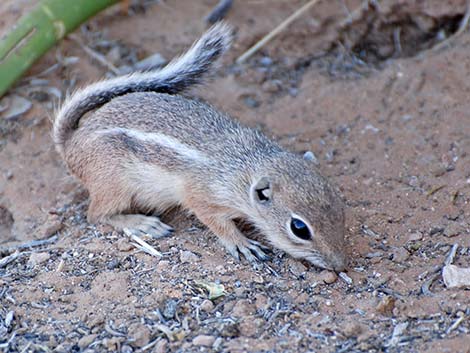 Sniffing the ground... |
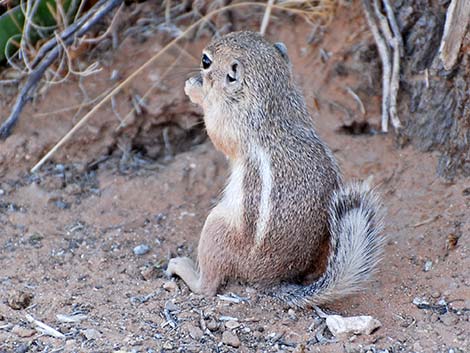 Success, the youngster found something to eat. |
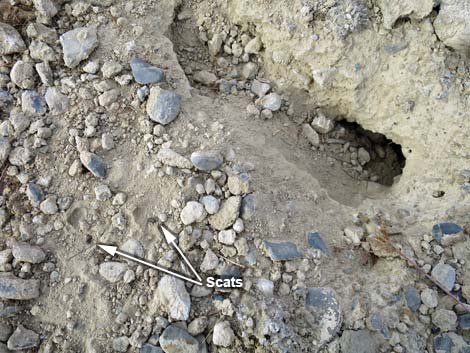 White-tailed Antelope Squirrel burrow and scat |
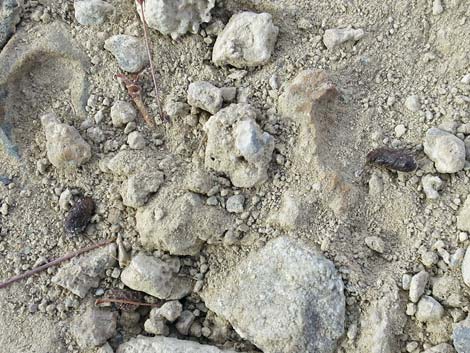 White-tailed Antelope Squirrel scat |
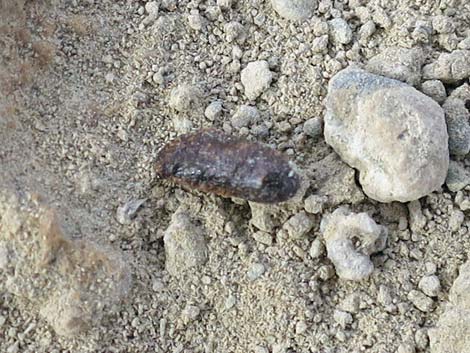 White-tailed Antelope Squirrel scat |
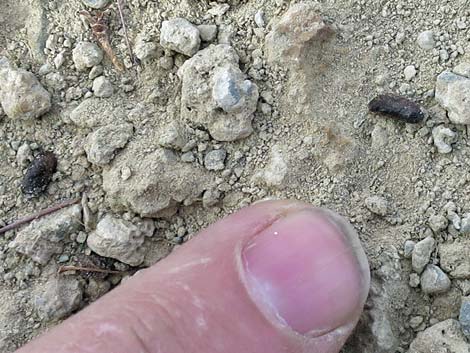 White-tailed Antelope Squirrel scat |
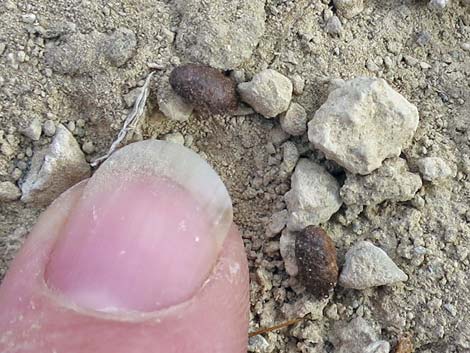 White-tailed Antelope Squirrel scat |
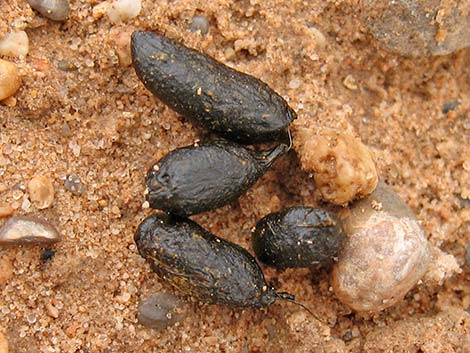 White-tailed Antelope Squirrel scat |
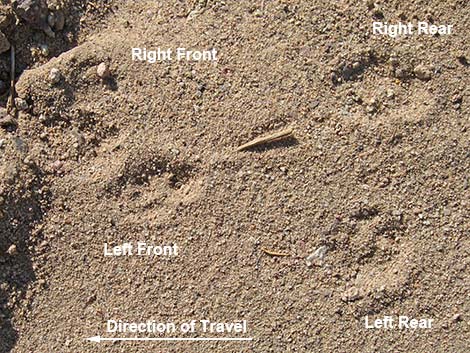 White-tailed Antelope Squirrel tracks in the sand |
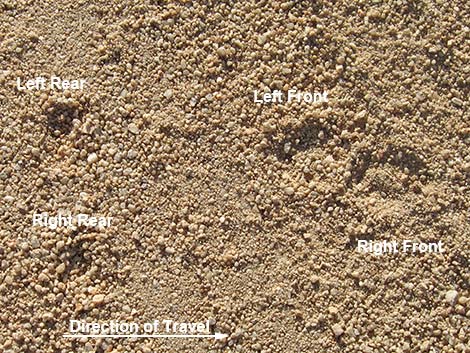 White-tailed Antelope Squirrel tracks in the sand |
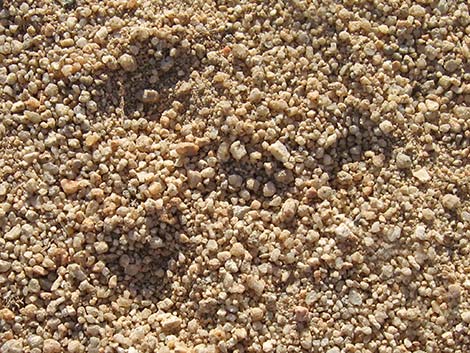 Tracks in the sand (direction of travel: right) |
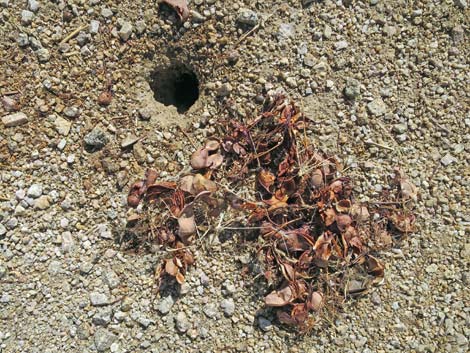 Spring cleaning: midden pile by burrow entrance Spring cleaning: midden pile by burrow entrance |
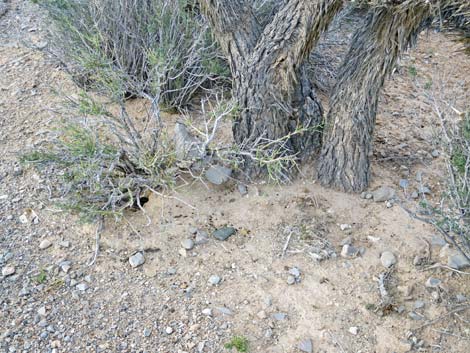 White-tailed Antelope Squirrel burrow |
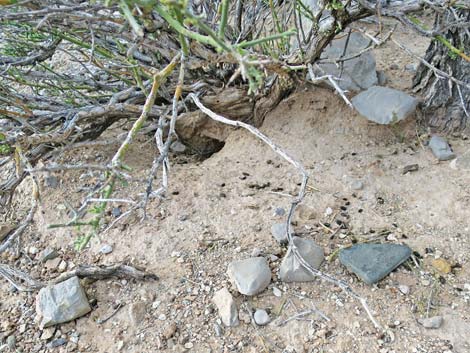 White-tailed Antelope Squirrel burrow |
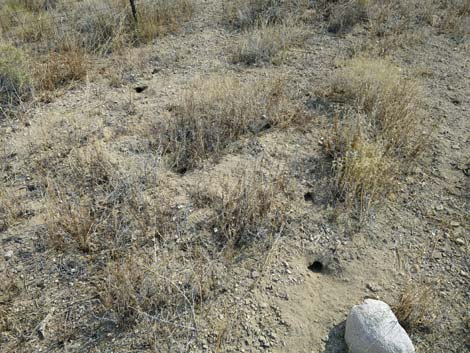 White-tailed Antelope Squirrel burrow complex |
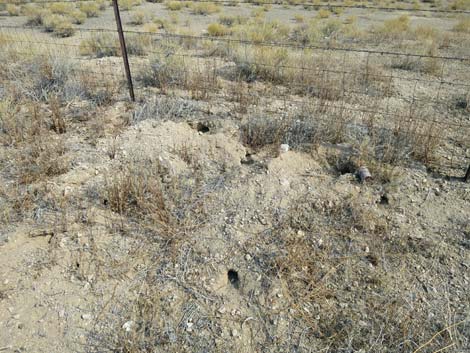 White-tailed Antelope Squirrel burrow complex |
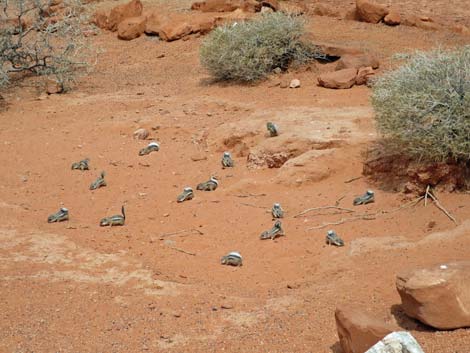 This is what happens when you feed the animals |
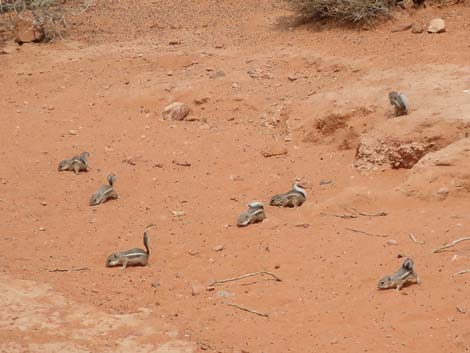 This is what happens when you feed the animals |
 ; Last updated 231221
| Mammals Around Las Vegas | Wildlife Around Las Vegas | Glossary | Copyright, Conditions, Disclaimer | Home |