
Birding Around Las Vegas
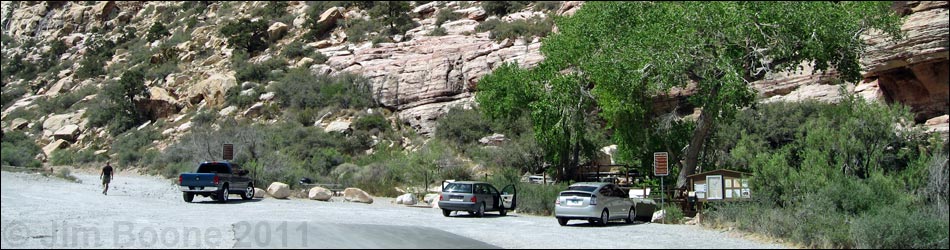
Red Rock Canyon National Conservation Area, is a U.S. Bureau of Land Management area located on the western edge of the Las Vegas Valley (map). In addition to other lands, the conservation area includes the spectacular red and white sandstone cliffs that can be seen from town. The cliffs lie up against the Spring Mountains, and as the name implies, there are many springs. The better birding is associated with springs, but there are no especially hot birding spots. Most of the springs are surrounded by dry Mojave Desert Scrub vegetation, so they bring in desert species seeking water and insects associated with the riparian vegetation. While the birding at Red Rocks rarely is spectacular, the scenery certainly is, and the place is worth a visit even with low expectations for birds. Except for weekends when it is too crowded, the Willow Springs Picnic Area usually has good birding.
Access to the Scenic Loop Road is controlled by a reservation system between November 3 through May 31 of each year. Timed Entry Permits are for a vehicle, not for people in the vehicle, and allows entry at the top of each hour with an allowance for 30-minute early arrival and 30-minute late arrival. For example, with a 9:00 am. Timed Entry Permit, visitors can enter the Scenic Loop Road between 8:30 am. and 9:30 am. Reservations are available through the Recreation.gov website and cost $2 each per day. All of the rest of Red Rock Canyon NCA remains free, and reservations are not required. For details, see Frequently Asked Questions on Timed Entry Permit System at Red Rock Canyon National Conservation Area.
For More Information and details of getting to Red Rocks, fees, hours, and other information, see the Red Rock Canyon Overview Page.
Note that while the Red Rocks National Conservation Area is a very large place, locals refer to the Scenic Loop area as "Red Rocks." When locals say they are going to Red Rocks, they are usually going to the Scenic Loop Drive area.
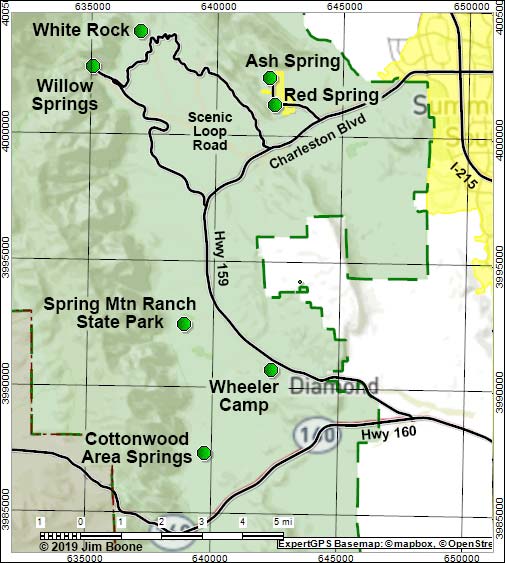 |
Ash Spring. Ash Spring and a seasonal stream support ash trees, shrubs, and meadows that attract birds and other creatures. Keep an eye out for desert tortoise and gila monsters. Cottonwood Valley Springs. Four small springs on desert flats provide water for vegetation, birds, and other wildlife. Requires driving on dirt roads or longer hikes from the pavement. Red Spring. Red Spring, and several smaller springs, emerge from the sandstone cliffs, supporting trees, shrubs, and a meadow. The Red Spring Boardwalk as fully accessible and provides easy access. Spring Mountain Ranch State Park. This historic homestead has lawns, pastures, cottonwood trees, springs, and a pond. The different habitats attract a wide variety of birds. Wheeler Camp Spring. This Audubon area preserves springs with cottonwood trees, willows, and mesquite thickets along a wash. Water attracts birds and other wildlife. White Rock Spring. A few minutes from the end of the road, this spring draws in birds, bighorn sheep, and other desert wildlife. Willow Springs Picnic Area. Located in a deep canyon, Willow Spring supports cottonwood trees and a variety of birds. Nearby Lost Creek Trail leads to stream and willow thickets at another spring. Keep an eye out for bighorn sheep and petroglyphs. |
Happy birding! All distances, elevations, and other facts are approximate.
 ; Last updated 240323
| Birding Around Las Vegas | Southern Nevada Birds | Glossary | Copyright, Conditions, Disclaimer | Home |