
Mammals Around Las Vegas, Wildlife Around Las Vegas
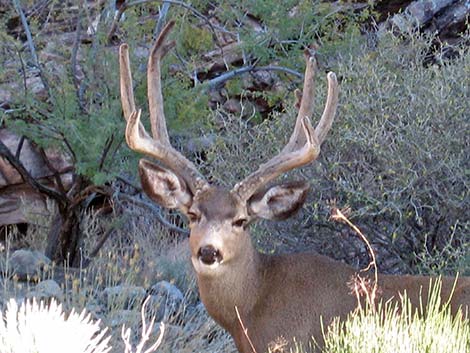
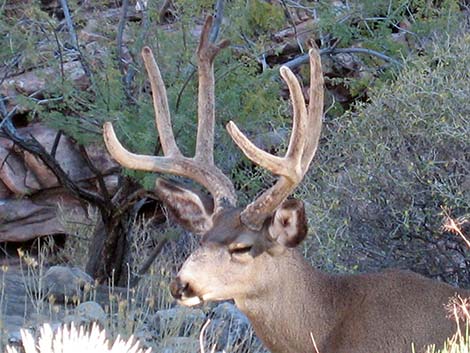 Each antler is formed from a main beam and several tines that come off the main beam |
General Information: White-tailed Deer (Odocoileus virginianus) are the most common deer in most of North America, but not in California, Nevada, Utah, or northern Arizona. Around Las Vegas, look for white-tailed deer on trips to the South Rim of the Grand Canyon and places farther south. White-tailed deer are recognized by the antlers (if they have them) or by the large white rump patch with a broad tail that is brown on top and white underneath. When a white-tailed deer is frightened, it will raise its tail like a big white flag and run off. It is thought that a predator will fixate on the white flag and not watch the head to anticipate where the deer is planning to turn next. Taxonomy: Order: Artiodactyla (Even-toed Hoofed Mammals); Family: Cervidae (Deer, Elk, Moose, Caribou). There are a large number of subspecies, including Carmen Mountains White-tailed Deer (Odocoileus virginianus carminis) and Coues White-tailed Deer (Odocoileus virginianus couesi) in the Western US. |
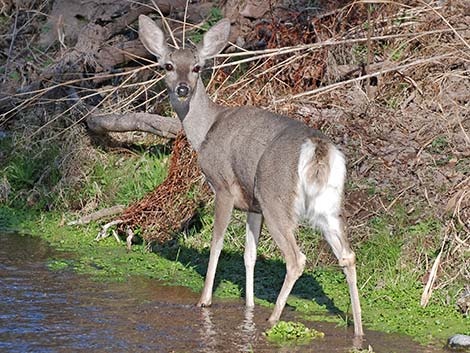 |
Technical Description: Height about 3 feet. Antlers (males only) are formed of a main beam with tines coming off the beam. Coat color tends to be reddish in the spring and gray in the winter. The hooves are in pairs; one pair primarily contacts the ground, and another usually remains slightly off the ground behind the first. Breeding: Deer breed in the fall (fall rut) and produce 1-2 young (fawns) in the spring. Diet: Vegetation; browse on shrubs and twigs. Range: White-tailed deer occur from southern Canada south to northern South America, but not in Nevada, Utah, northern Arizona, and adjacent areas. Comments: White-tailed Deer originally occurred in eastern North America, but have been widely introduced into the west for hunting. The antlers of white-tails are different from those of mule deer (see photo below). On road signs warning of deer, the animal pictured is a white-tailed deer -- one would think that we could use a western deer out here! |
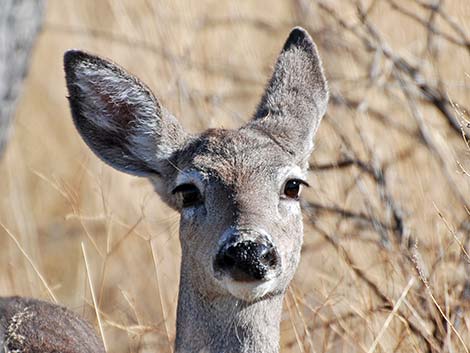 |
If you were a tasty bit of shrub, this might be the last face you ever see! |
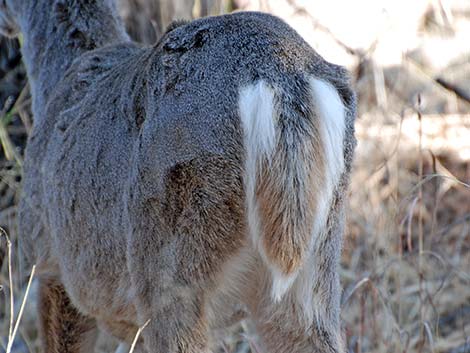 White-tailed deer have a tail that is brown on top and all white under |
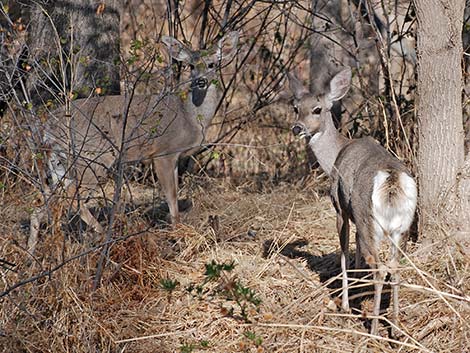 White-tailed deer have a large white rump patch |
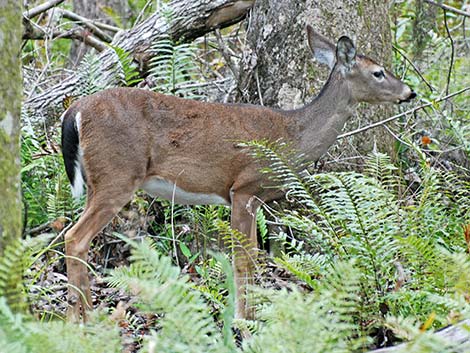 White-tailed Deer female; Dunedin, Florida |
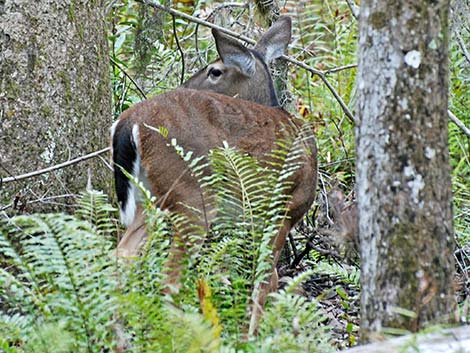 White-tailed Deer female; Dunedin, Florida |
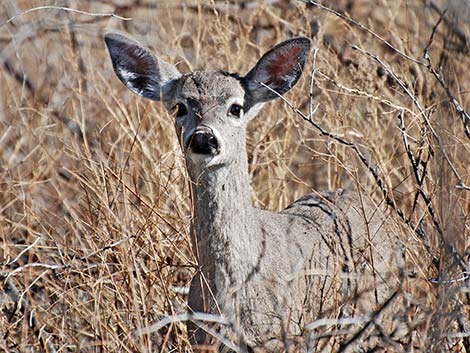 |
 |
Note: All distances, elevations, and other facts are approximate.
 ; Last updated 231229
| Mammals Around Las Vegas | Wildlife Around Las Vegas | Glossary | Copyright, Conditions, Disclaimer | Home |