
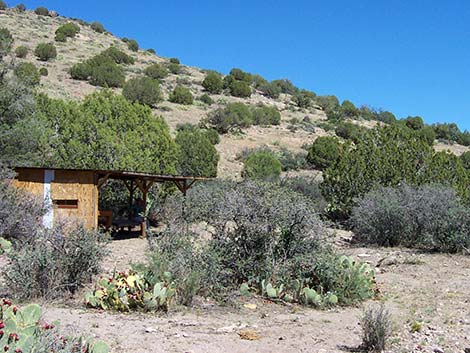
 ZT cabin area (view east) |
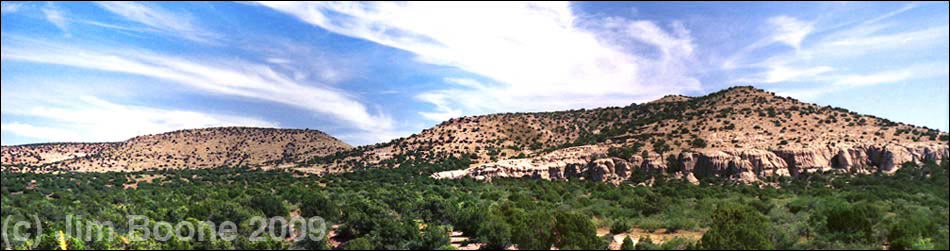
The Zone-tailed Ranch is a 320 acre (half of a section; one mile long and half a mile wide) piece of beautiful desert near the crest of the Aquarius Mountains, Arizona, at an elevation of about 5,000 feet. It is located east of Kingman (east of US-93) and south of I-40. The road from the interstate is only 22 miles long, but it takes about an hour to get to our place because the road is so rough. The road is partially maintained by the Mohave County, but parts are only maintained by landowners -- and we all use 4-wheel drive trucks. |
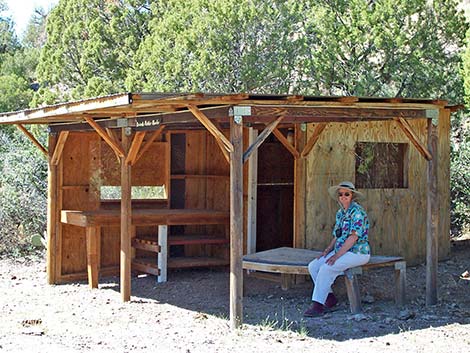 Liz at the cabin (view NW) |
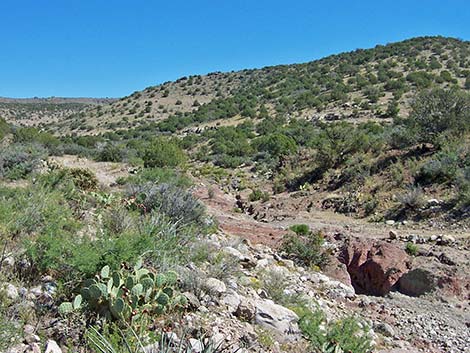
All of the land in the area is divided into 1-square-mile checker-board pattern where all of the "red" squares are state land and the "black" squares are private. Therefore, the Zone-tailed Ranch is bordered on three sides by state land. It has been, and continues to be, part of a working cattle ranch that has been in operation since the early 1900s. It is not terribly overgrazed. The land is rocky canyon country with cliffs, seasonal streams, and perennial springs. The Zone-tailed Ranch is just above the level of the cliffs where the land starts to flatten out and includes one major mountain top and one major canyon with a seasonal steam. |
 Front porch (view E) |
The vegetation is dominated by Utah Juniper with some pinyon, oak, cactus, yucca, and a diverse collection of shrubs and annual plants. It is located in an area of transition between the Pinyon-Juniper highlands and the Sonoran Desert lowlands. Perennial vegetation covers about 20% of the ground, but in the spring after a wet winter, the entire area looks like an alpine meadow. The only "improvement" is a shack that we built. Actually, it is just a 17-ft by 12-ft shade structure with one side and a box on the back. We use the cabin for shade, be we still camp on the ground, sit by campfires, hike about, and enjoy the solitude. Unfortunately, vandals have been hard on the cabin. |
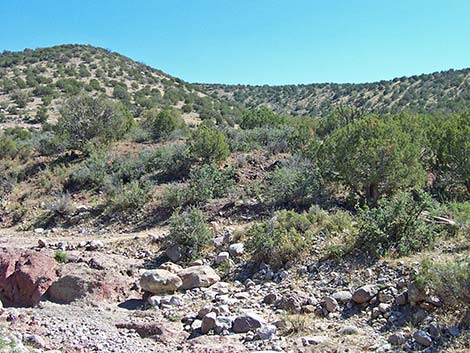 Wash below cabin (view SE) |
Wildlife is abundant. We regularly see many species of birds, as well as reptiles, amphibians, and mammals. We don't know the invertebrates well, but we see many "bugs," aquatic insects, and other spineless creatures during the warmer seasons. Noteworthy birds include Zone-tailed Hawks, Golden Eagles, Olive Warblers, Hepatic Tanagers, and our old friends the Dark-eyed Juncos. We have greater and lesser earless lizards, rattlesnakes, desert spiny lizards, and at least one 7-foot-long gopher snake. Amphibians include lowland leopard frogs, canyon tree frogs, and red-spotted toads. The mammal fauna includes the usual complement of rodents (e.g., woodrats, kangaroo rats, deer mice, and rock squirrels), plus such unusual species as javelina, raccoons, and skunks. Harris's antelope ground squirrels and desert cottontail occur here despite differences with the range maps. |
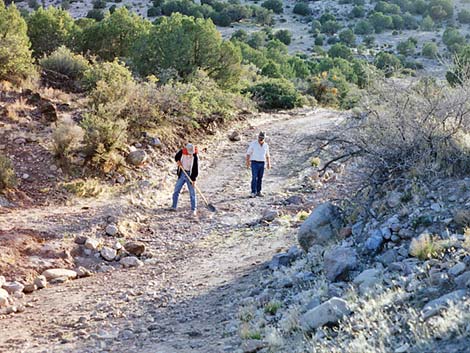 |
Our road is long, narrow, and rough. Most of the road to the ranch is maintained by the county or the ranchers, but we maintain about three quarters of a mile of our road by hand. We don't maintain the rest of the road because we would rather leave it washed out to discourage vehicle traffic up our canyon. The road was blocked off (by ranchers?) near the top of pass to the east anyways, so we are just encouraging nature to block it off sooner. In April 1996, my dad and I worked for several hours on a washed out section of the road just west of the cabin. It was still passable in a 2-wheel drive vehicle until 2005, when we had to fix it again. It's all pretty my 4x4 vehicle territory these days. |
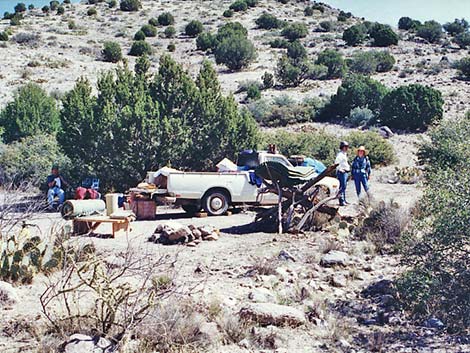 |
This is our campsite. Few things in life are finer than camping on our own half-section of Arizona wilderness. |
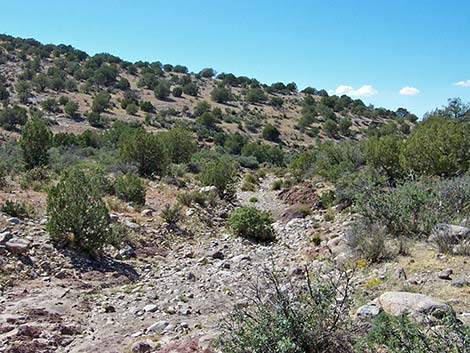 Wash below cabin (view W) |
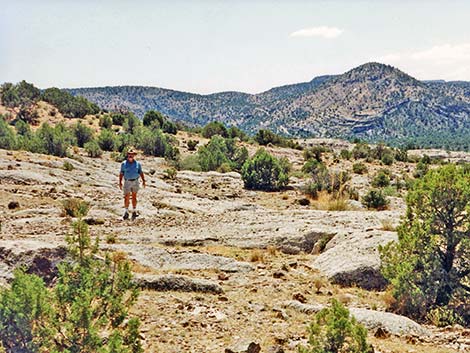 Bluffs west of the cabin (view south) |
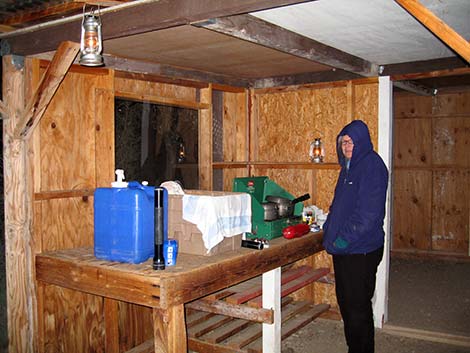 Liz in the kitchen |
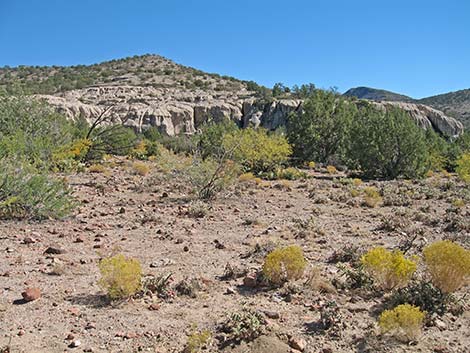 Cliffs on west end of the property |
Note: All distances, elevations, and other facts are approximate.
 ; Last updated 240222
| Home |