
Lizards Around Las Vegas, Wildlife Around Las Vegas
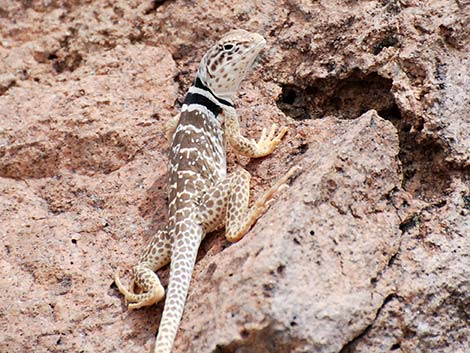 Adult male Collared Lizard |
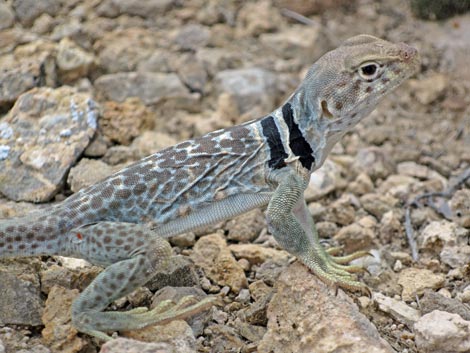
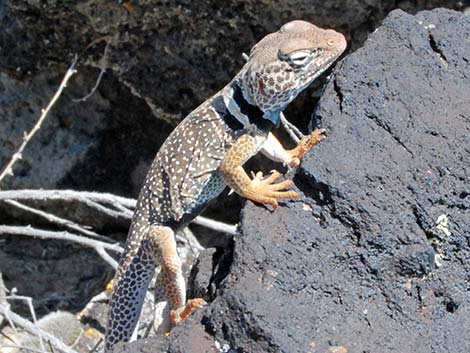
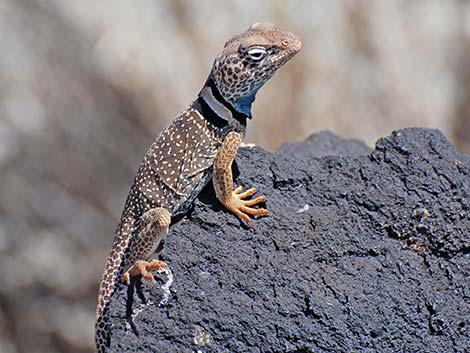
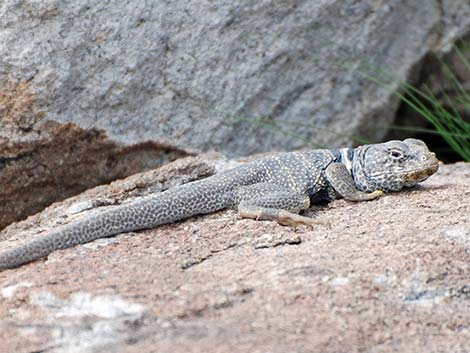
General Description: Great Basin Collared Lizards (Crotaphytus bicinctores), with a big head, big powerful jaws, and the ability to run on their hind legs, are the Velociraptors of the desert. They are easily recognized by the smooth scales (looks like skin, not scales) and two black neck bands. The body is variously marked with bands and spots. Taxonomy: Collared and Leopard Lizard Family (Crotaphytidae). Formerly Desert Collared Lizard (Crotaphytus insularis), subspecies Great Basin Collared Lizard (Crotaphytus insularis bicinctores). Technical Description: A moderately large (total length 9 to 11 in.) lizard with a stocky body and a relatively large head. The body color is dark with contrasting light spots and bars, while the color of the tail and limbs are light with contrasting dark spots. This species can be recognized from other species of large lizards by the presence of two black neck-bands. The background color varies, and it can be green during the breeding season in the spring. |
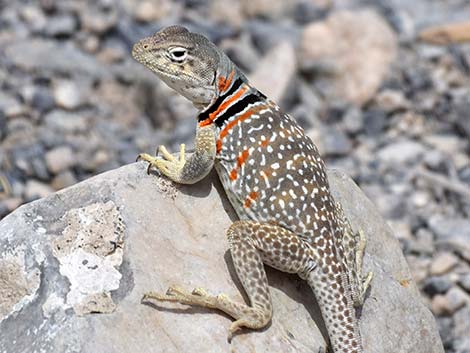 Adult female Collared Lizard in breeding colors |
Some other species of lizards in southern Nevada (e.g., Desert Spiny Lizards) have dark marks on the neck, but none has the two complete neck bands seen on Collared Lizards. These lizards have fine, smooth scales that look more like skin than scales. The tail is laterally flattened. Diet: These lizards are voracious predators that can run on their hind legs to capture prey or escape other predators. They feed on insects, lizards, small rodents, berries, and leaves. Habitat: Occurs in a variety of habitats including Mojave desert scrub, salt desert scrub, mesquite/catclaw, desert riparian, blackbrush, sagebrush, and pinyon-juniper habitats (Lower Sonoran, Upper Sonoran, and Pinyon-Juniper Woodland habitat types) in rocky terrain: arroyos, hill slopes, washes with sparse vegetative cover up to an elevation of 7,500 ft. |
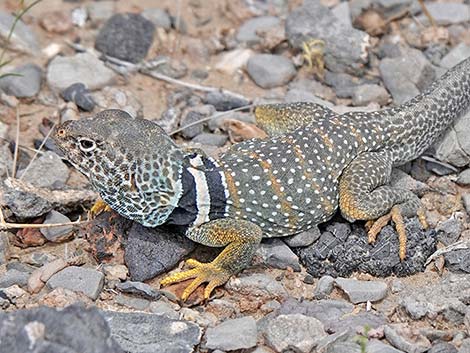 Lots of color variation in this species |
Range: The species occurs throughout the Great Basin and the other southwestern deserts north of Mexico. Around Las Vegas, look for this species in desert areas with plenty of large rocks. Breeding: Breeds in the spring. When gravid, females get orange bars on the sides of the body. Similar Species: No other species in Nevada has two black neck bands, but in areas to the east, watch for Eastern Collared Lizards, which are more colorful and have tails that are round in cross section. Comments: |
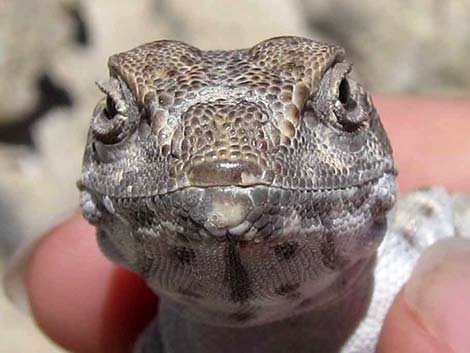 |
If you were a little lizard, this might be the last face you ever see! |
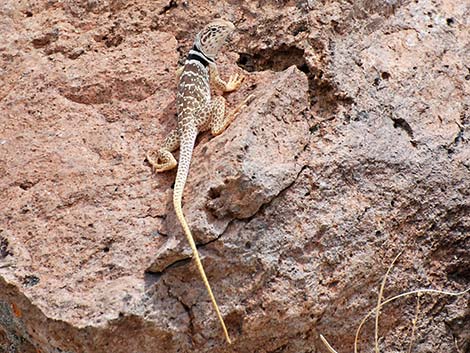 |
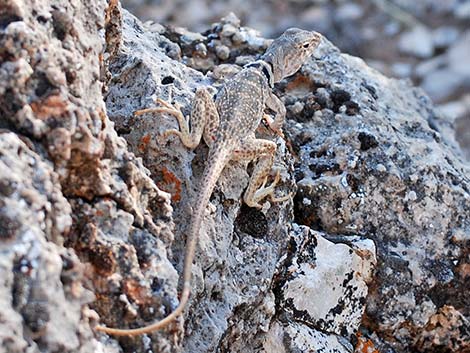 |
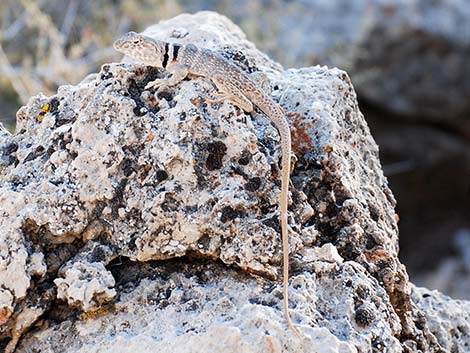 Pale lizard from the Grand Canyon |
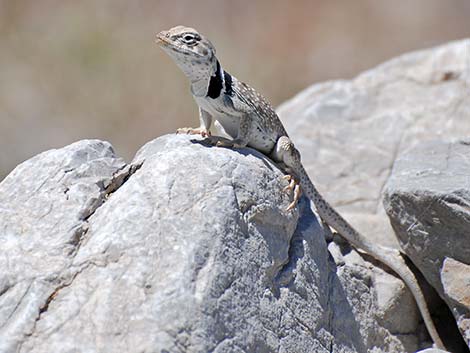 Great Basin Collared Lizard |
 |
 |
 |
 |
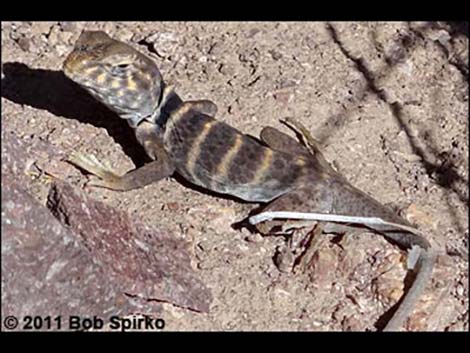 Nice banding pattern with spots (© 2011 Bob Spirko, Death Valley) |
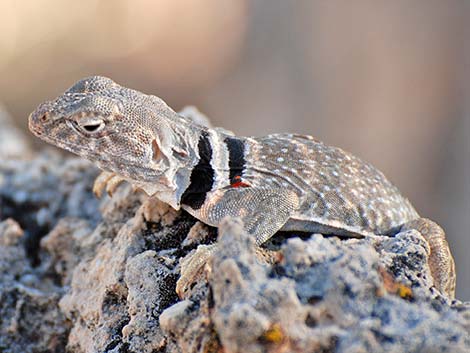 Great Basin Collared Lizard |
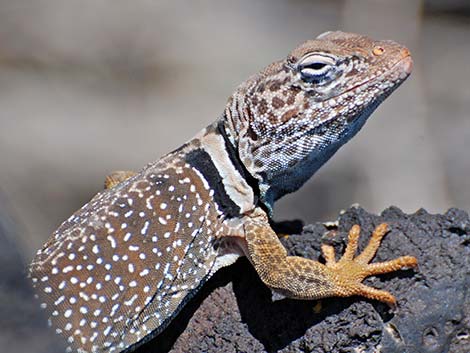 |
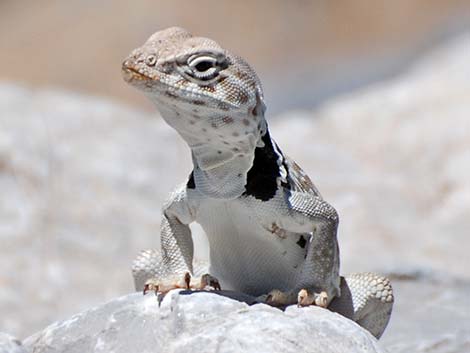 |
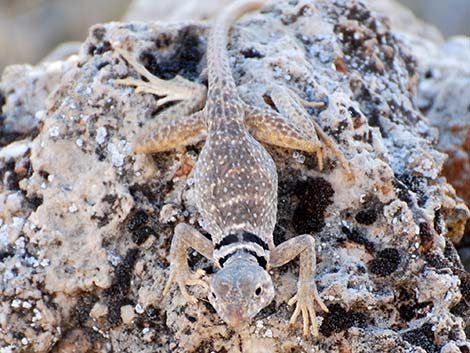 Great Basin Collared Lizard |
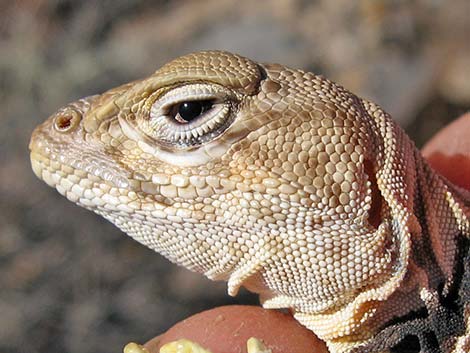 Scale patterns on head. Note the fringe around the eyes |
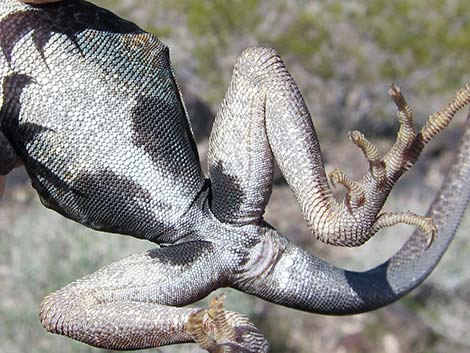 Collared Lizard male: black patches on lower belly and thighs |
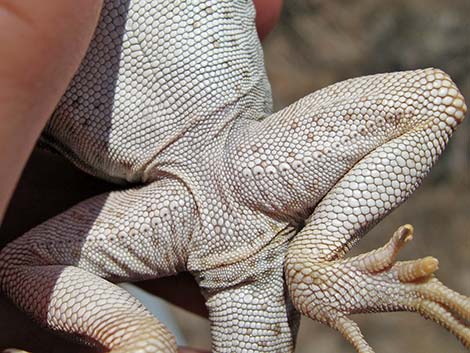 Collared Lizard female: no black patches on lower belly or thighs |
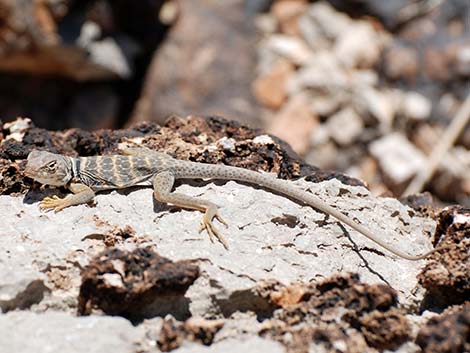 Collared Lizard female |
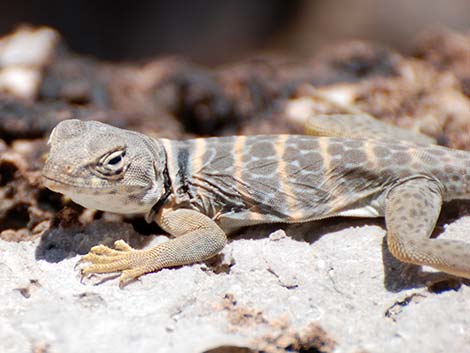 Collared Lizard female |
Note: All distances, elevations, and other facts are approximate.
 ; Last updated 231213
| Lizards Around Las Vegas | Wildlife Around Las Vegas | Glossary | Copyright, Conditions, Disclaimer | Home |