
Shrubs Around Las Vegas, Vegetation Around Las Vegas
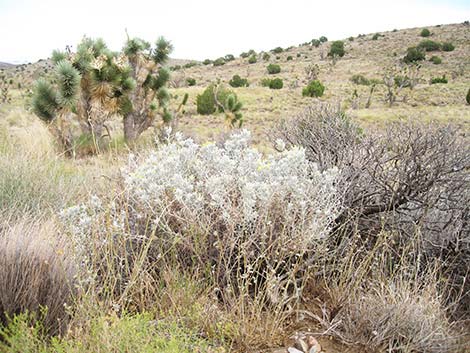 |
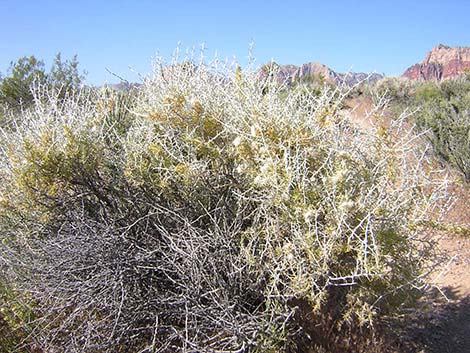
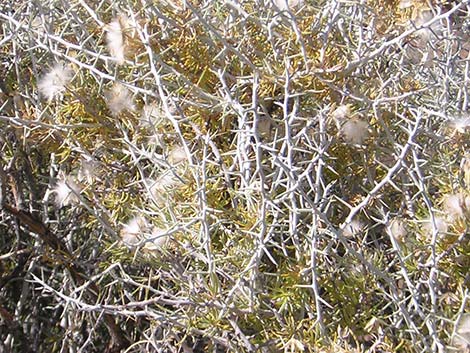
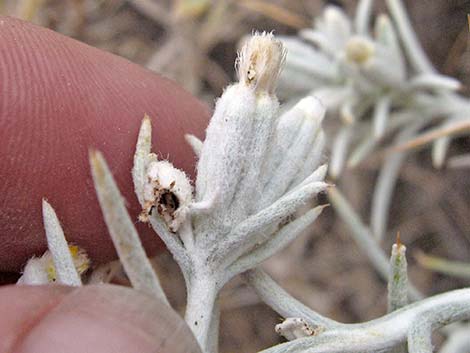
General: Mojave Cottonthorn (Tetradymia stenolepis) is an upright, spiny shrub growing 3-4 feet tall with often leafless, bright white stems. During spring and early summer, the seedheads produce many hairs that look like cotton or cotton balls stuck onto the twigs. Mojave Cottonthorn is a fairly common component of shrub communities on well-drained sandy, gravelly, and rocky soils on upper bajadas and moderate slopes into the lower mountains in the Upper Sonoran (Mojave Desert Scrub and Pinyon-Juniper Woodland) life zone. Family: Sunflower (Asteraceae). Other Names: Cotton-thorn, Horsebrush, Tetradymia |
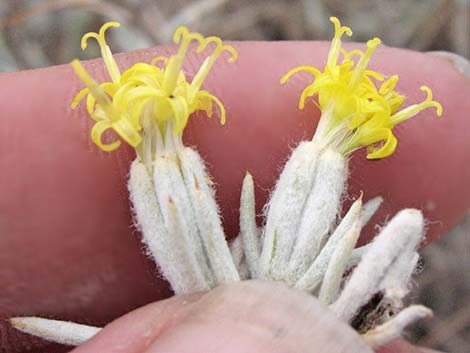
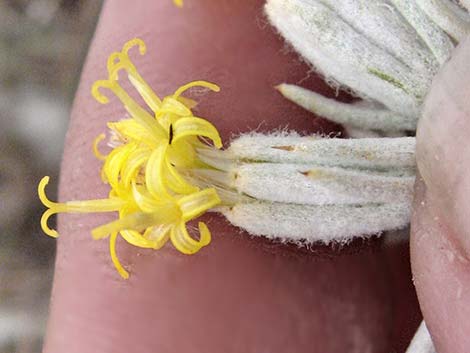 Few yellow flowers per head |
Plant Form: Upright, drought deciduous shrub. Height: To about 4 feet. Bark: Silvery white (bright white). Stems: Unevenly covered with short, dense, matted silvery hairs below. Stems tend to grow straight upright with straight, 1-inch spines that grow perpendicular to the stems. Leaves: Two kinds of leaves: main and clustered. Main leaves grow on new stems and form the spines. Clustered leaves grow in axils. Clustered leaves are alternate, oblanceolate, silvery, to about 1-1/4 inch long, and hairy. Flowers: Blooms spring through summer. Inflorescence: composite heads with up to 7 disk flowers. Flowers: few per disk, yellow. |
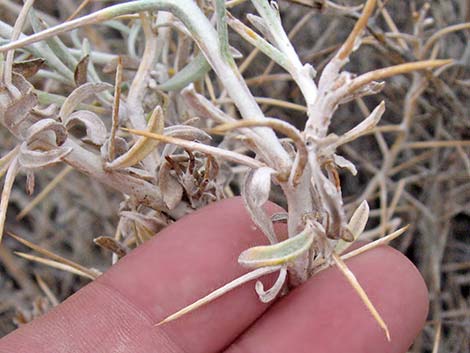 Clustered leaves hairy |
Seeds: Fruits hairy. Tiny achene (like a tiny sunflower seed) with many fine bristles. Habitat: Dry, well-drained sandy, gravelly, and rocky soils on upper bajadas and moderate slopes in the lower mountains. Elevation: About 2,000 to 5,000 feet. Distribution: California and southern Nevada. Comments: |
 |
 |
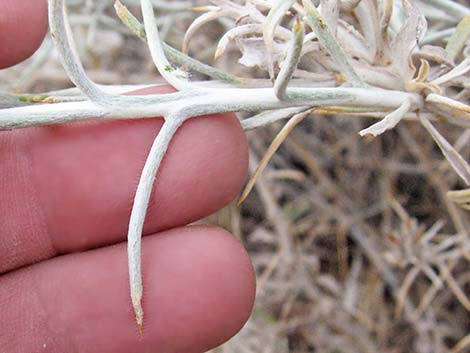 Fresh stems with cottony thorns |
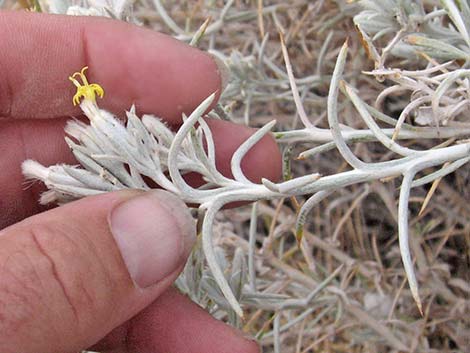 Fresh stems with cottony thorns |
 |
 |
Note: All distances, elevations, and other facts are approximate. Names generally follow the USDA database.
 ; Last updated 220109
| All Shrubs | Plant Species Index | Glossary | Copyright, Conditions, Disclaimer | Home |