
Shrubs Around Las Vegas, Vegetation Around Las Vegas
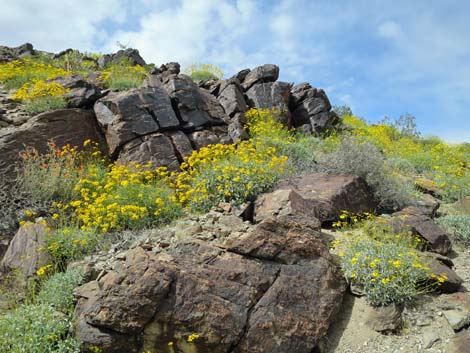 Fairly large shrub in typical habitat |
General: There are three species of Brittlebush (Encelia spp.) in the Las Vegas area. All three are small, rounded, knee-high to thigh-high shrubs with relatively large gray leaves and with many flower stalks extending above the tight ball of leaves. Each flower stalk is tipped with a large, yellow, daisy flower. The flower stalks often persist after the leaves are dropped. The three species differ in the flower stalks and the flowers. In one species, Goldenhills (E. farinosa; typical brittlebush), the flower stalk is branched, with one flower at the tip of each branch, while the flower stalk is unbranched in the other two species. In Virgin River Brittlebush (E. virginensis), each unbranched stalk terminates with a single flower, which is a typical daisy flower. In the third species, Button Brittlebush (E. frutescens), each unbranched stalk terminates with a single flower, but the flowers lack the fringe of “petals” (i.e., ray flowers) seen on typical daisy flowers. Brittlebush is a common component of vegetation communities along washes, on bajadas, and on the lower slopes of mountains in the Upper Sonoran (Mojave Desert Scrub and Pinyon-Juniper Woodland) life zone. It can also be common component of hot, dry vegetation communities in the Lower Sonoran (Creosote-Bursage Flats) life zone. |
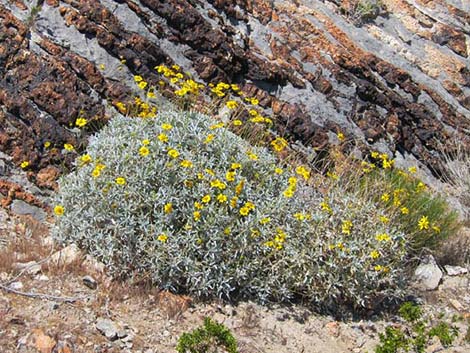 Typical form: ball of leaves with flowers sticking out |
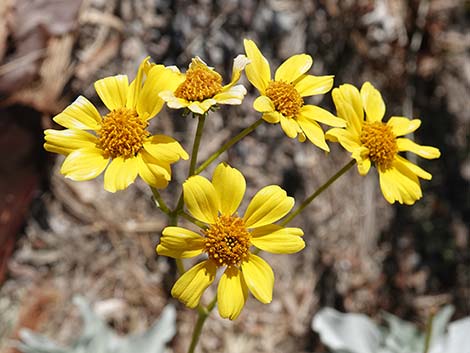
Family: Sunflower (Asteraceae). Other names: Brittlebush, brittle bush, inceinso, white brittle bush Plant Form: Small to medium sized, drought-deciduous shrub with a woody base and a rounded, much-branched form. A thicket of small branches supports an umbrella of relatively large, gray leaves. Height: Usually about knee-high; to 3 ft. Bark: Gray. Stems: Woody base with many short branches. Leaves: Triangular (2 inches long), with a narrow tip and broad (1/2 to 1 inch wide) base, simple, smooth edge, alternate; silvery-gray to whitish; underside hairy. Leaves located toward the ends of branches. Flowers: Blooms in spring, also sporadically in response to rain. Flowers daisy-like, yellow, 2-inch diameter, on long brittle stalks held above the leaves. |
 |
Seeds: Many small seeds; dispersed long distances by wind. Habitat: Hot, dry, well-drained sandy, gravelly, and rocky soils. Elevation: To about 3,000 feet. Distribution: Occurs across the southern deserts from California to southwestern Utah and south into Baja California and northwestern Mexico. Comments: Brittlebush is browsed by mule deer (Odocoileus hemionus) and desert bighorn sheep (Ovis canadensis), but it has little value for domestic livestock. Kangaroo rats (Dipodomys spp.) eat the seeds. Brittlebush is hardy and easy to grow (transplants and seeds), making it useful for rehabilitating disturbed areas and for use in low maintenance landscapes (e.g., roadsides). Brittlebush leaves produce a toxic substance that inhibits the growth of winter annuals. |
 Notice the branched flower stalks |
Goldenhills (Encelia farinosa) -- This is the typical "brittlebush." In this species, each flower stalk is branched, with one flower at the tip of each branch, making many flowers per flower stalk. |
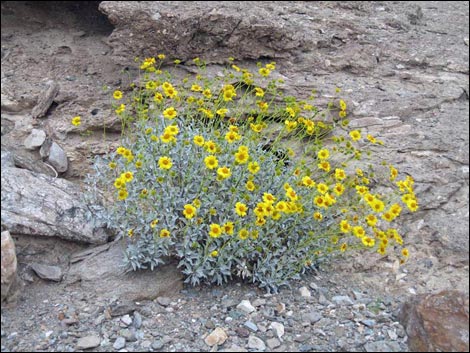
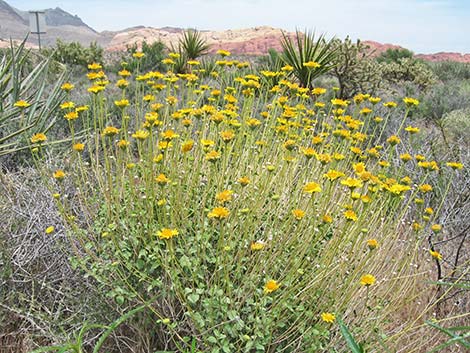 Notice the unbranched flower stalks |
Virgin River Brittlebush (Encelia virginensis) -- In this species, the flower stalk is unbranched, and each stalk terminates with a typical daisy flower (includes ray and disk flowers). |
 Notice no sunflower "petals" |
Button Brittlebush (Encelia frutescens) -- In this species, the flower stalk is unbranched and each unbranched stalk terminates with a flower. However, the flower lacks the fringe of "petals" (i.e., ray flowers) seen on typical daisy flowers. |
Note: All distances, elevations, and other facts are approximate. Names generally follow the USDA database.
 ; Last updated 220718
| All Shrubs | Plant Species Index | Glossary | Copyright, Conditions, Disclaimer | Home |