
Cactus Around Las Vegas, Vegetation Around Las Vegas
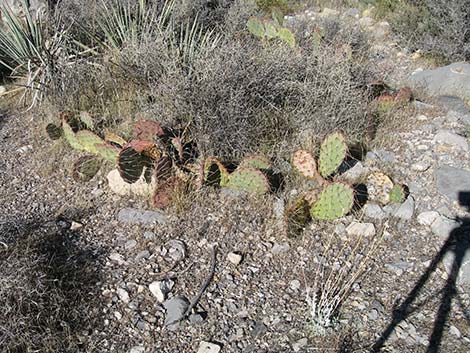 |
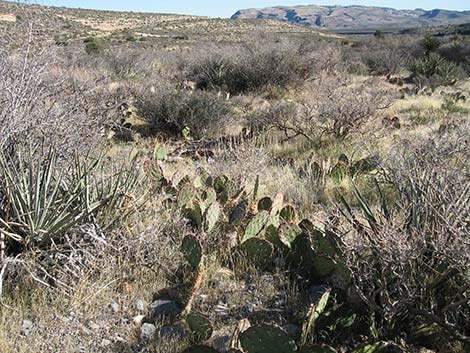
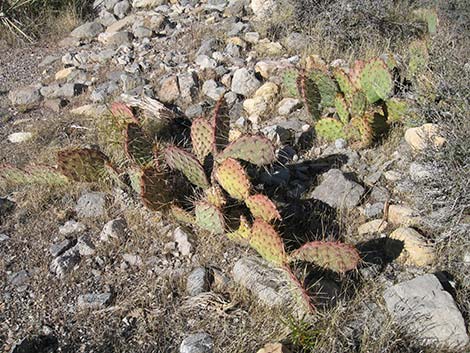
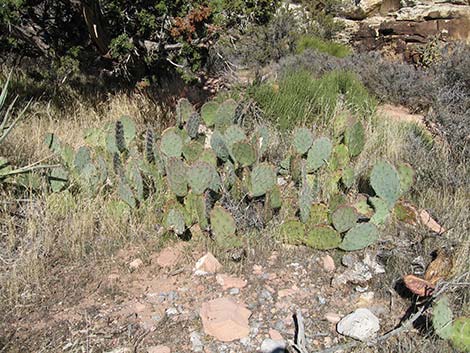
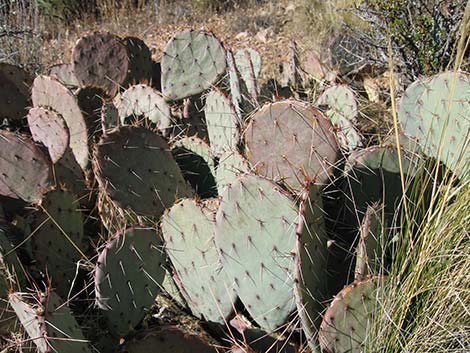
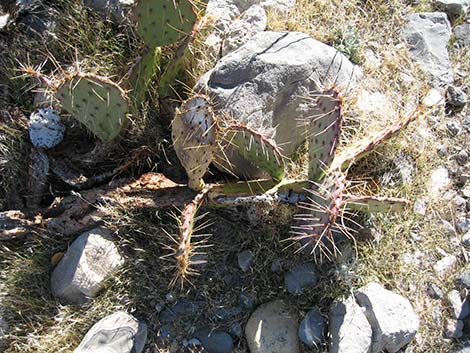
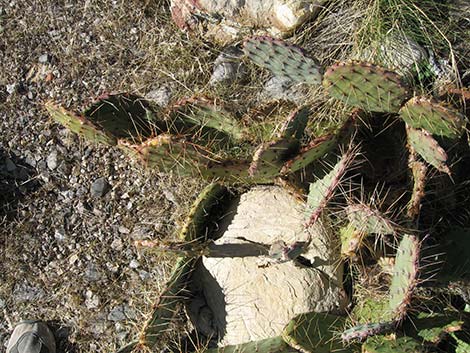
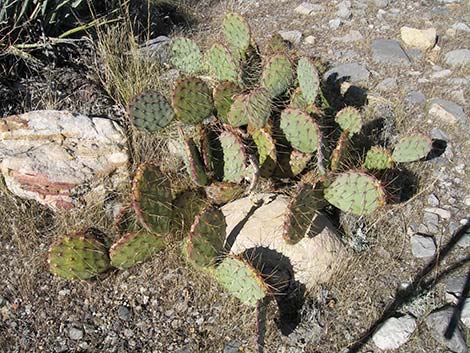
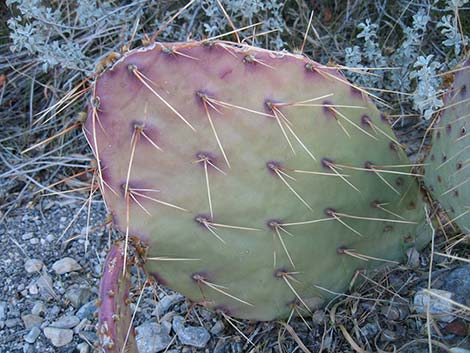
General: Tulip Pricklypear (Opuntia phaeacantha), or Brown-spined Pricklypear, typically is a low-growing, spreading cactus with flat stem segments (pads), but sometimes it grows more upright. The pads are relatively long and broad, and the spines are usually confined to the upper 70% of the pads. Areoles (where the spines originate) usually spread about 3/4-inch apart, and areoles without spines can be seen at the base of each pad. Spines typically long near the top of the pad and shorter lower down; longer spines gray with reddish base, flattened; shorter spines all gray. Glochids absent on the side of the pads. Flowers yellow, usually with red at the base of the petals. Fruit is a fleshy "cactus apple" with a green interior. Pricklypear can be difficult to identify; sometimes it is better to just call it a pricklypear and let it go at that. Tulip Pricklypear is locally common (not found everywhere, but can be abundant where it occurs) component of vegetation communities on well-drained sandy, gravelly, and rocky soils along washes and on upper bajadas and moderate slopes into the lower mountains in the Lower Sonoran (Creosote-Bursage Flats) and Upper Sonoran (Mojave Desert Scrub and Pinyon-Juniper Woodland) life zones. Occasionally found in the Transition (Yellow Pine Forests) and Canadian (Pine-Fir Forest) life zones. |
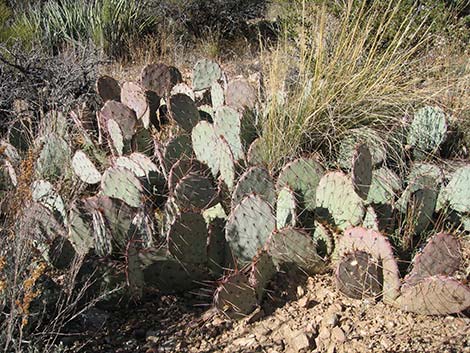 |
Around Las Vegas, this species is most easily seen at Red Rock Canyon NCA in the Willow Springs area where dense stands occurs between the Lost Creek Trailhead and the Willow Springs Picnic Area. Family: Cactus (Cactaceae). Other Names: Brown-spined Pricklypear, Plains Pricklypear, Opuntia arizonica, Opuntia camanchica, Opuntia canada, Opuntia charlestonensis, Opuntia dulcis, Opuntia engelmannii var. cycloides, Opuntia gilvescens, Opuntia mojavensis, Opuntia phaeacantha var. brunnea, Opuntia phaeacantha var. camanchica, Opuntia phaeacantha var. major, Opuntia phaeacantha var. mojavensis, Opuntia phaeacantha var. nigricans, Opuntia phaeacantha var. phaeacantha, Opuntia phaeacantha var. superbospina, Opuntia superbospina, Opuntia woodsii. Plant Form: low-growing, spreading shrub. Height: Usually to about knee high (to 3 feet). Trunk: None. |
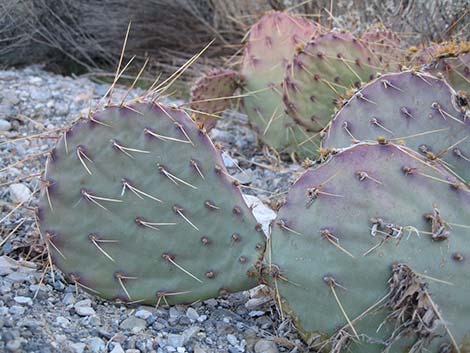 |
Stems: Divided into segments; flat and broad (pancake shaped), oval, to about 1-foot long. Stem Surface: Smooth. Spines: Usually 1 to 4 (often 2 or 3) spines per areole, usually confined to areoles on the on the upper 70% of the pad (usually no spines at the base of the pad). Longest spines (usually along the top of the pad) flattened, to about 3-inches long. Larger spines usually grayish with reddish-brown near the base (about 1/3 inch); smaller spines reflexed, grayish. Glochids: Present, usually dense along the upper edge of the pads, but few on the sides of the pads. Flowers: Blooms during early summer. Inflorescence: flowers solitary along upper edge of pads (set atop developing fruit). Flowers: Flower: yellow with red at the base of the petals; to about 1-1/2-inches diameter; filaments white; style white, stigma greenish. |
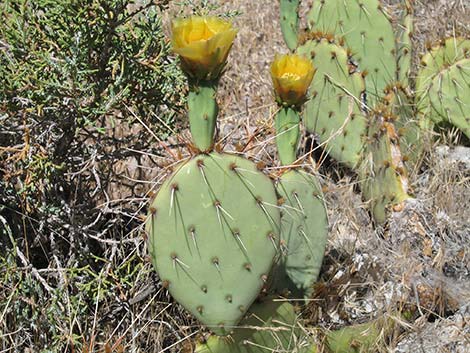 Flowers set atop developing fruits |
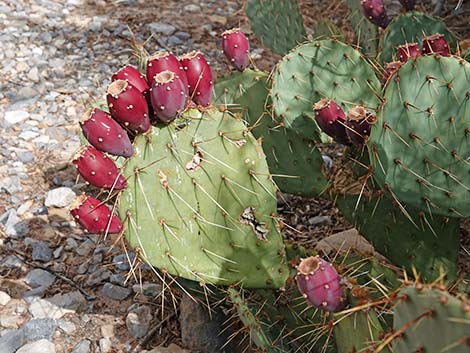
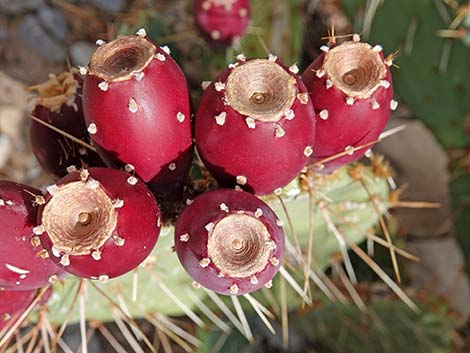
Fruit: "Cactus apple." Fruit juicy, purplish exterior with green interior; 1 to 2-1/2-inches long. Spines absent, but glochids present in the 15–32 areoles. Seeds: Small, to about 6 mm. Habitat: Dry, well-drained sandy, gravelly, and rocky soils on upper bajadas and moderate slopes in the lower mountains. Distribution: California to Kansas, south through Texas into Mexico. Also South Dakota. Elevation: About sea level to 7,300 feet. Comments: Pricklypear species hybridize, sometimes making identification difficult. This confusion is evidenced by the plethora of scientific names (see Other Names, above) assigned to populations of this species. |
 |
 |
 |
 |
 |
 |
 |
 |
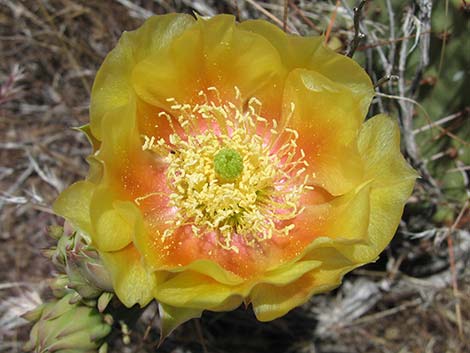 Flowers yellow with reddish at base of petals |
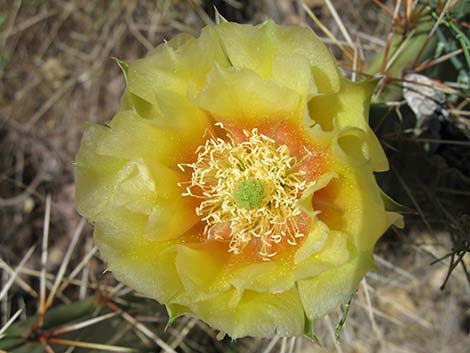 Flowers yellow with reddish at base of petals |
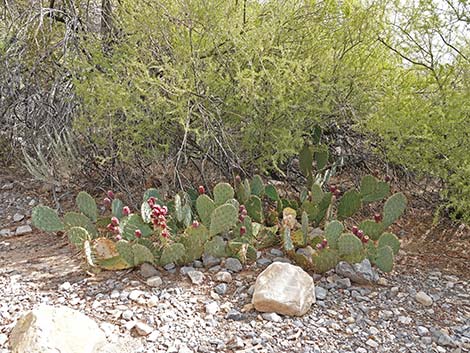 Tulip Pricklypear with ripe fruits (cactus apples) |
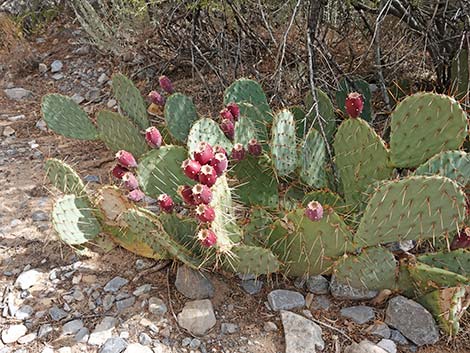 Tulip Pricklypear with ripe fruits (cactus apples) |
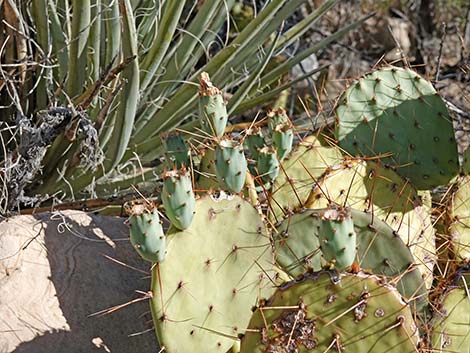 Tulip Pricklypear with developing fruits |
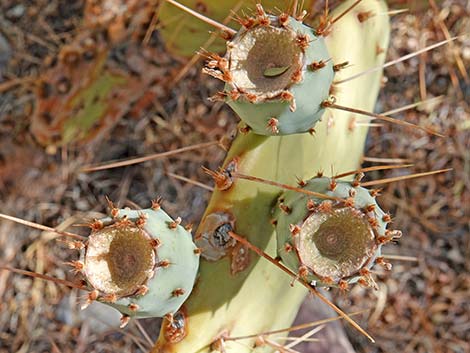 Tulip Pricklypear with developing fruits |
 |
 |
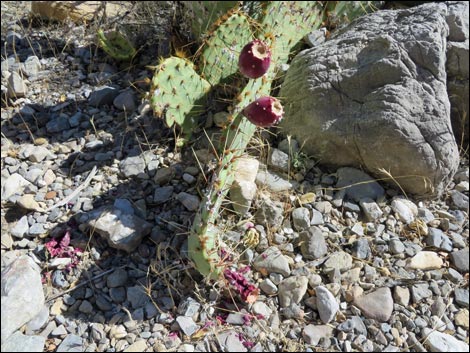 Somebody has been eating the fruit |
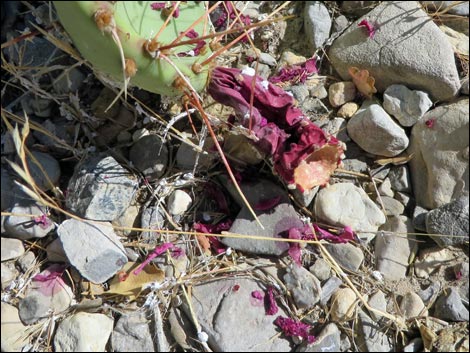 Somebody has been eating the fruit |
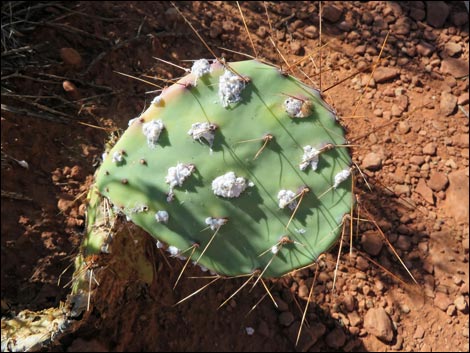 Tulip Pricklypear infested with Cochineal (Hemiptera) |
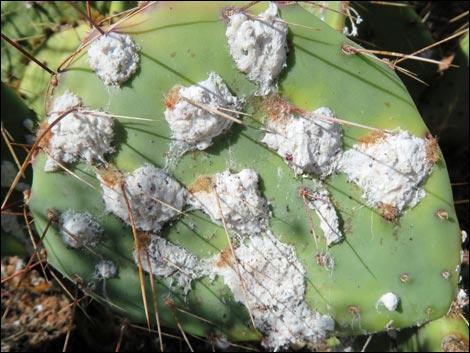 Tulip Pricklypear infested with Cochineal (Hemiptera) |
Note: All distances, elevations, and other facts are approximate. Names generally follow the USDA database.
 ; Last updated 220816
| All Cactus | Plant Species Index | Glossary | Copyright, Conditions, Disclaimer | Home |