
Hiking Around Las Vegas, Spring Mountains (Mt. Charleston)
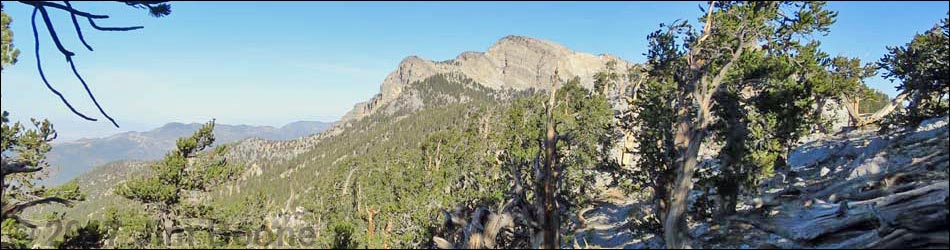
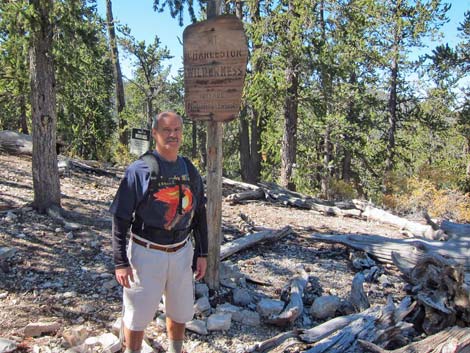 Hiker at Mt. Charleston Wilderness Area boundary (view SW) |
Overview This strenuous, 16-mile trail runs along the crest of the Spring Mountains, connecting the Bristlecone Trail (Lee Canyon; south end) with the Bonanza Peak Trail (Cold Creek; north end). Starting at either end, the trail runs west to the crest of the mountains, follows the crest, passes west of McFarland Peak, picks up the crest again, and drops eastward to the other trailhead. Hiking south to north mostly puts the sun at your back and gives an 1,100-ft elevation advantage. The Lee Canyon Trailhead (8,668 ft) is higher than the Cold Creek trailhead (7,550 ft), but the trail can be walked in either direction. Link to map. |
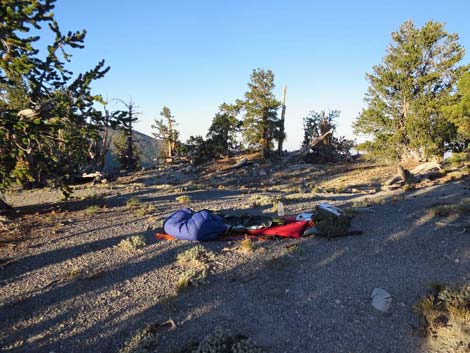 Dry camp on the ridgeline south of McFarland (view W) |
Much of the trail is forested with Ponderosa Pine, White Fir, and Quaking Aspen at lower elevations, and Bristlecone Pine at higher elevations. From the crest, spectacular views spread north and south along the Spring Mountains crest, and east and west across deserts and mountain ranges into the distance. This one-way hike requires shuttling vehicles or making other arrangements at the two trailheads. Water historically has been available at Wood Spring during spring and early summer, otherwise the trail is dry. Watch Out Other than the standard warnings about hiking in the desert, this is a pretty safe hike. There are some rocky spots where a slip could prove hazardous, but this is a good, safe trail. The trail is strenuous, so take it easy at these elevations if you've just come up from the desert. There is little water along this trail, and unless you are hiking during spring, don't rely on getting water at Wood Spring. Note that AllTrails and other phone-mapping systems show the old version of this trail, which was rerouted over a decade ago. Follow my maps and the trail, not your phone, and you should be okay. |
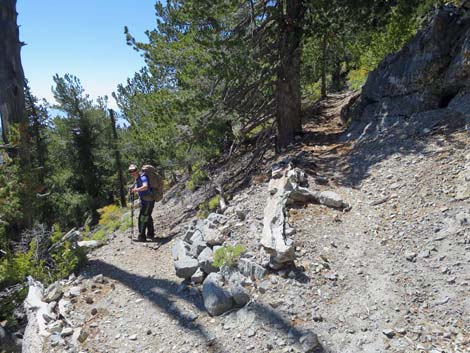 Southbound hiker on trail above Wood Spring (view W) |
While hiking, please respect the land and the other people out there, and try to Leave No Trace of your passage. Also, this is a long hike, so be sure to bring the 10 Essentials. Please stay on the trail and don't cut the switchbacks. Cutting switchbacks damages the trail and the vegetation, makes trail conditions worse for everyone, and forces the cash-strapped U.S. Forest Service to waste money fixing trails. Getting to the Trailhead This hike is located in the Spring Mountains National Recreation Area, northwest of Las Vegas. Because this is a point-to-point trail, there are two trailheads: the Upper Bristlecone Trailhead or Lower Bristlecone Trailhead in Lee Canyon, and the Bonanza Trailhead above Cold Creek. For the northbound route, start at one of the Bristlecone Trailheads. To get to Upper or Lower Bristlecone Trailhead, head out to the Spring Mountains National Recreation Area and drive to the end of Lee Canyon Road. |
Bonanza Trail Northbound -- Divided into 7 Segments (follow the link to details of each segment)
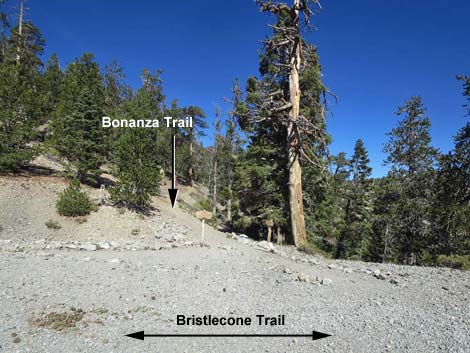 Bristlecone-Bonanza trail junction (view N) |
The Hike -- Segment 1 -- Bristlecone Trailhead to Bonanza Trail (2.37 or 2.93 miles) From the Upper Bristlecone Trailhead, it is about 2.37 miles to the start of the Bonanza Trail, and from the Lower Bristlecone Trailhead, it is about 2.93 miles to the start of the Bonanza Trail. The hiking probably is easier from the Lower trailhead because it follows gentle grades on an old road, but the Upper trailhead is a trail in the woods. Starting from either trailhead, the trail runs uphill into a mixed Quaking Aspen and conifer forest with plenty of shade and grand views all around, although the trail from the lower trailhead has much more open sun and more expansive (tree free) views. Either way, the Bristlecone Trail eventually arrives at the well-marked junction with the Bonanza Trail. |
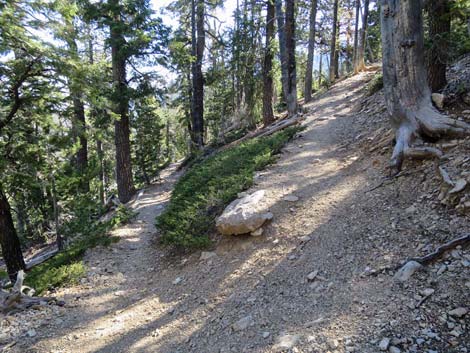 Switchback on the way to the Crest of the Range (view SE) Switchback on the way to the Crest of the Range (view SE) |
The Hike -- Segment 2 -- Bristlecone Trail to Crest of the Range (0.76 miles) From the Bristlecone Trail (Wpt. 03), the Bonanza Trail runs northwest and climbs towards the skyline far above. Climbing through the Pine-Fir Forest thick with White Fir, Ponderosa Pine, and Bristlecone Pine, plus a carpet of Common Juniper in a few places, the trail winds upward passing four switchbacks. After turning the last switchback, the trail makes a long climb to a saddle on the crest of the Spring Mountain Range (0.76 miles out). On the crest, hikers get views down the west side into the Pahrump Valley and mountain ranges disappearing into the western haze. Look for the Kingston Range, Telescope Peak in Death Valley, and perhaps the Sierra Nevada Mountains in the far distance. Views east are mostly obscured by a thick forest of tall Bristlecone Pine. This saddle is a nice destination, but it also provides access to a use-trail heading south on the crest of the ridge with connections to use-trails that loop down to the Bristlecone Trail or continue to other destinations. |
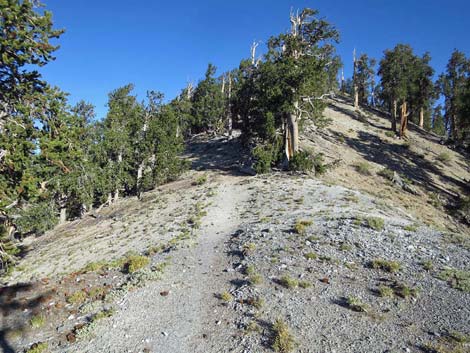 Trail on the Crest of the Range (view N) |
The Hike -- Segment 3 -- Crest of the Range to McFarland Peak Trail Junction (3.0 miles) From the saddle on the crest of the Spring Mountain Range, the Bonanza Trail heads up the ridgeline to the north. Much of the ridgeline is rocky, so the trail generally follows one side or the other and contours around most of the highpoints. At about 0.6 miles from the saddle, the trail climbs steeply five short switchbacks to pass a steep, rocky knob, then continues more gently northward, still contouring around the highest points. In places, views are great off one side or the other. At 1.8 miles from the saddle, the trail passes two switchbacks and while staying on the ridgeline, begins a descent towards the north toe of McFarland Peak (2.5 miles from the saddle). Here, the trail drops off the west side of the ridge and contours downward across the West Face of McFarland Peak. The trail hits the first of 6 switchbacks, which is the junction of the use-trail to McFarland Peak. |
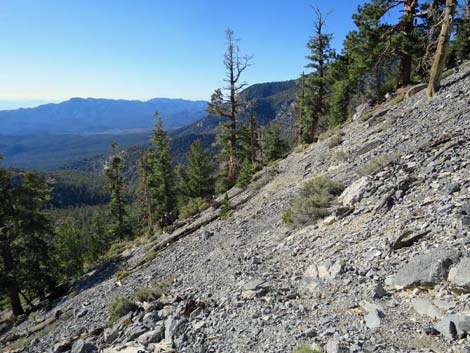 Little used trail traversing below McFarland Peak (view NW) |
The Hike -- Segment 4 -- McFarland Peak Trail Junction to McFarland Gully -- Northwest (1.8 miles) From the junction to McFarland Peak, the trail drops through a total of six short switchbacks and reaches the gully that cuts the Southwest Face of McFarland Peak. From the Great Southwest Gully, the trail continues northward traversing below the towering limestone West Face of McFarland Peak. At about 0.4 miles past the Great Southwest Gully, the trail runs up onto the crest of the West Ridge of McFarland Peak with grand views back to the south. Turning the corner at the ridgeline, the trail begins switchbacking down the north side of the ridge. After dropping through two long and two short switchbacks, the trail descends northward (with one tiny switchback) to the top of 14 mostly steep, short switchbacks. After passing the insult of the poorly designed switchbacks, the trail contours more gently into the Great Northwest Gully that cuts the North Face of McFarland Peak (1.7 miles out). |
 Wood Spring (view N) Wood Spring (view N) |
The Hike -- Segment 5 -- McFarland Gully to Wood Spring (0.8 miles) From the deep woods in the Great Northwest Gully, the trail contours west and up across the slope until climbing three short switchbacks to a saddle behind a craggy knob. The trail continues contouring upward and runs into a deep, narrow gully. Turning up the gully, the trail steeply climbs 3-4 (depending on what you count) rocky switchbacks and quickly arrives at Wood Spring (0.8 miles out). Water historically is available here in the spring, but with the climate changing and the land drying out, water is unreliable. The spring box is rusting too, which makes it more difficult to collect water. Campsites are available up the trail a few yards off to the west on the nearby ridgeline. |
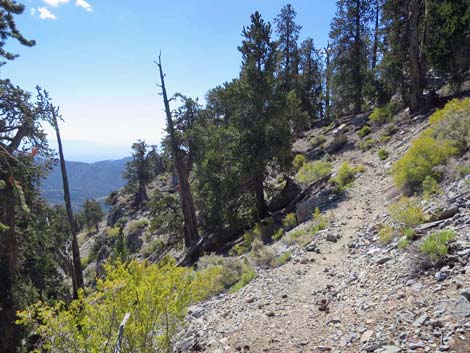 Trail traverses hillside below Bonanza Peak (view NW) |
The Hike -- Segment 6 -- Wood Spring to Bonanza Peak Junction (2.25 miles) From Wood Spring, the trail continues up the narrow gully. About 40 yards beyond Wood Spring, the trail forks. The left crosses the gully and runs up to a couple of campsites. The right continues northward. Just past the fork, the trail passes two short switchbacks, then begins a long, gentle series of 11 switchbacks. In contrast to the switchbacks across the canyon, these were well designed. From the 11th switchback, the trail contours up and across a broad, wooded slope to 4, and then 2, short switchbacks, followed by 4 longer switchbacks, another contour, 4 more short switchbacks, and finally a contour onto the West Ridge of Bonanza Peak (1.95 miles out). The switchbacks are gentle, but they seem to go on forever. Turning straight up the ridgeline, the trail climbs until abruptly turning left to contour up and across the slope below Bonanza Peak to near the North Ridge of Bonanza Peak and a junction (2.25 miles out) with a use-trail to the summit. Bagging the peak adds another 0.5 miles to the hike, and it is too close to pass up. |
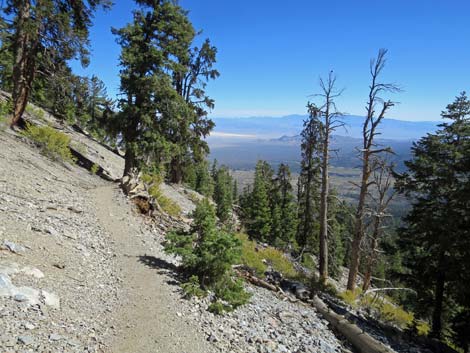 Descending gentle trail towards Cold Creek Trailhead (view NE) |
The Hike -- Segment 7 -- Bonanza Peak Junction to Bonanza Trailhead (4.6 miles) From the junction with the use-trail to Bonanza Peak, the Bonanza Trail follows down the North Ridge, staying on the west side, to pass several high points. At about 0.4 miles out, the trail begins switchbacking down the west side of the ridge to bypass rocky outcrops on the ridgeline. After 10 (depending on what counts) switchbacks, the trail contours down the ridgeline, passes two short switchbacks, and drops into Bonanza Saddle (1.1 miles out). Dropping off the east side of the ridge, the trail descends some 70 switchbacks, interspersed with long contours and couple of steep runs straight down ridgelines. The trail eventually ends at Bonanza Camp Trailhead (4.6 miles out). |
Table 1. Hiking Coordinates Based on GPS Data (NAD27; UTM Zone 11S). Download hiking GPS Waypoints (*.gpx) file.
| Wpt. | Location | UTM Easting | UTM Northing | Elevation (ft) | Point-to-Point Distance (mi) | Cumulative Distance (mi) |
|---|---|---|---|---|---|---|
| 01 | Bristlecone Trailhead | 618756 | 4018569 | 8,684 | 0.00 | 00.00 |
| 02 | Trail Junction | 617097 | 4019064 | 9,267 | 2.53 | 02.53 |
| 03 | Saddle on Crest of the Range | 616561 | 4019085 | 9,756 | 0.76 | 03.29 |
| 04 | McFarland South Ridge | 614661 | 4021707 | 9,751 | 2.55 | 05.84 |
| 05 | McFarland Peak Junction | 614075 | 4021920 | 9,532 | 0.46 | 06.30 |
| 06 | McFarland West Ridge | 613471 | 4021945 | 9,381 | 0.46 | 06.76 |
| 07 | Top of 6 Switchbacks | 613410 | 4022545 | 9,100 | 0.60 | 07.36 |
| 08 | McFarland Gully NW | 613426 | 4023176 | 8,652 | 0.74 | 08.10 |
| 09 | Ridge below Wood Spring | 612829 | 4023219 | 8,831 | 0.52 | 08.62 |
| 10 | Wood Spring | 612673 | 4023559 | 9,039 | 0.27 | 08.89 |
| 11 | Top of 11 Switchbacks | 612888 | 4023969 | 9,586 | 0.94 | 09.83 |
| 12 | W Ridge of Bonanza Peak | 612151 | 4024328 | 10,116 | 1.03 | 10.86 |
| 13 | Bonanza Peak Junction | 612373 | 4024663 | 10,230 | 0.29 | 11.15 |
| 14 | Bonanza Peak | 612465 | 4024350 | 10,397 | . | . |
| 15 | Bonanza Saddle | 611671 | 4025516 | 9,803 | 1.15 | 12.30 |
| 16 | Bonanza Trailhead | 613021 | 4026870 | 7,513 | 3.44 | 15.74 |
Happy Hiking! All distances, elevations, and other facts are approximate.
 ; Last updated 240329
| Hiking Around Mt Charleston | Hiking Around Las Vegas | Glossary | Copyright, Conditions, Disclaimer | Home |