
Birding Around Las Vegas, Desert National Wildlife Range
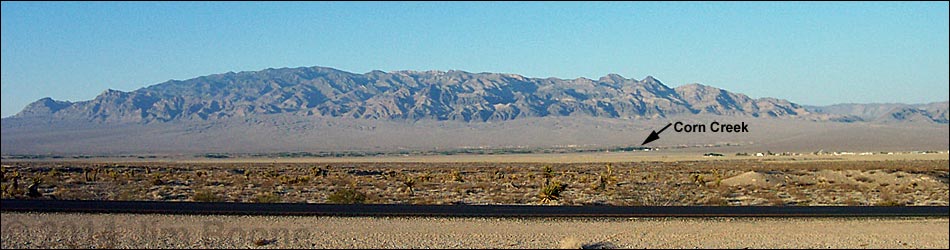
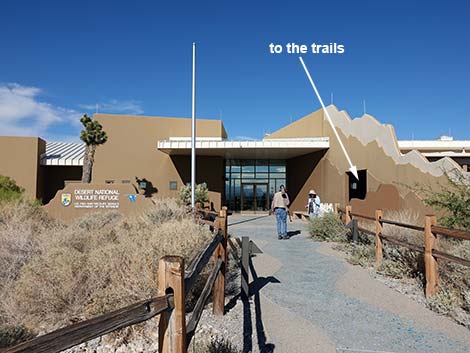 Corn Creek Visitor Center and to the birding trails (view N) |
Overview Corn Creek, about 30 northwest of town, is a tiny spot of green in a vast sea of Mojave Desert Scrub that attracts desert birds and migrant species like a magnet. Of all the places to watch birds around Las Vegas, historically this has been the best place to find desert species, seasonal migrants, and unusual migrants -- this is where the birds showed up. Water brings in desert species, trees attract migrants (fruit and cover), and the area is small enough to work it over and follow birds from one side to the other, but habitat changes seem to be leading to an uncertain future. Despite habitat changes, this remains a good place to bird during spring and good place for watching dragonflies. Several short trails provide access for birders: Coyote Trail, Bighorn Trail, Wandering Ben Trail, Birdsong Trail, and Roadrunner Trail. |
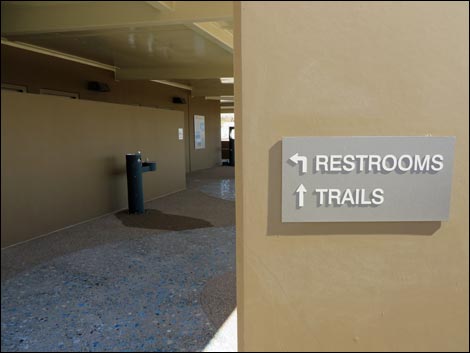 To the birding trails (view E) |
Description Corn Creek is a desert oasis located on the edge of a broad, flat valley at the foot of the Sheep Mountains. Several springs in the area provide water for Honey Mesquite, Cottonwood Trees, and wetland plant species. Two springs were used by late-1800s homesteaders, and these springs still provide water for the pond, trees, grass, and orchards that remain. During spring and summer, watch for Phainopepla, desert warblers, desert sparrows, thrashers, and hummingbirds; and during fall, watch for migrants and eastern warblers. This site is also good for falcons, accipiters, flycatchers, orioles, tanagers, grosbeaks, and buntings. Winter generally is quiet, but there is always something flitting about. Most of the habitat immediately surrounding Corn Creek is low-elevation Mojave Desert scrub (creosote bush, white bursage, fourwing saltbush, and a few Mojave yucca). This area is in the rain shadow of the Spring Mountains (to the west), so it gets less rain than usual even for a desert, and as a result the vegetation is sparse and stunted. |
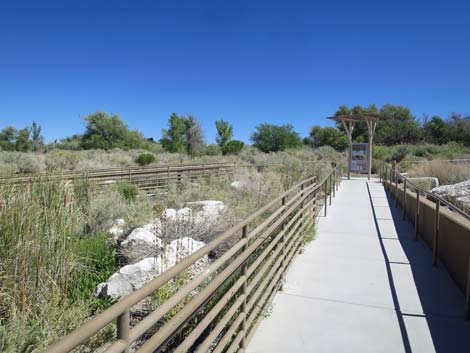 Departing the Visitor Center: start of trail system (view NE) |
To the north of Corn Creek, a long strip of Mesquite-Sand Dune Woodland habitat runs up the valley. This vegetation is supported by subsurface water flow and a few springs. Much of the Las Vegas Valley was covered by similar Sand Dune Woodlands before development. To the west of Corn Creek (along the access road), a broad saltbush flat covers the bottom of the valley. To the east, the Sheep Range rises to elevations of about 10,000 feet. These mountains have extensive Pinyon-Juniper Woodlands, smaller areas of Yellow-Pine Forest, and even Bristlecone Pine Forests at highest-elevations. These woodlands provide habitat for montane species that sometimes come down to Corn Creek. There are no services at Corn Creek, so be sure you have enough gas to get there and back. Bring water and snacks. Picnicking is not allowed at Corn Creek. |
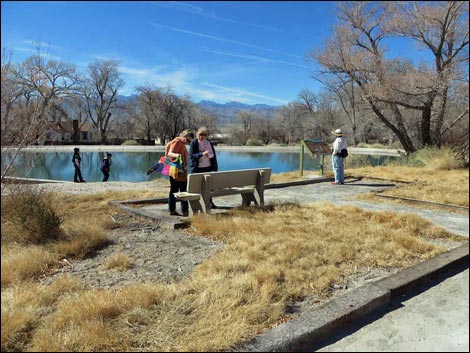 Cement Pond with information sign and bench during winter |
Location Corn Creek Field Station is located northwest of Las Vegas on the Desert National Wildlife Range (a federal wildlife refuge), about 30 minutes northwest of downtown Las Vegas off Highway 95. For detailed directions, see Corn Creek Field Station. Hours The Wildlife Range is always open, but Corn Creek is open sunrise to sunset. The Visitor Center is open Friday to Sunday, 8 AM to 4:30 PM. Fees None. |
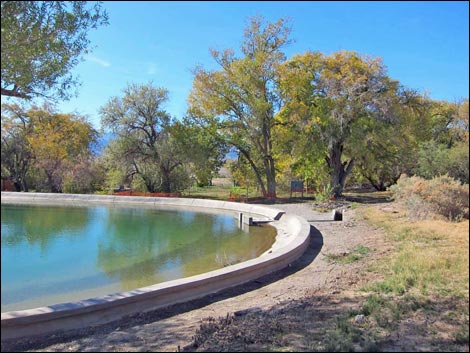 Northeast side of cement pond (view NW) |
Birding Corn Creek While driving into the area on Corn Creek Road, watch the saltbush flats for Horned Larks, desert sparrows, and Le Conte's Thrashers; also check the sky for swallows, hawks, and other soaring birds. Approaching Corn Creek, birders first arrive at the southwest corner of the old horse pasture. Stop here and check the trees and power lines for perching birds. Continue up the main road past the pasture and the maintenance buildings to the Visitor Center parking lot (some parking is shaded). Before entering the area, check the parking area for Phainopepla in the Honey Mesquite, Gambel's Quail and Black-throated Sparrows among the shrubs, and hawks and swallows in the sky. Here, the interface between the desert and the oasis, is a good place to see for desert species (e.g., Greater Roadrunner, Mourning Dove, and House Finch) coming in for water. |
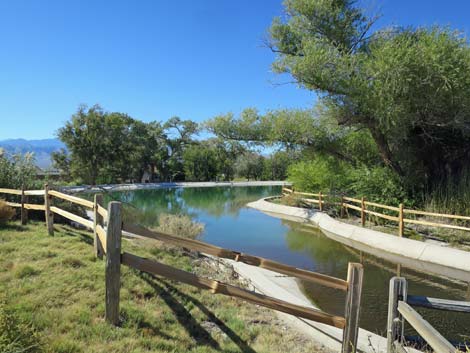 Cement Pond behind the visitor center |
From the parking area, walk up to the Visitor Center. If the Visitor Center is open, birders can walk through the building to the trails, otherwise turn right through a doorway into a covered patio area and enter the birding area off the far corner of the building. Walking out and staying left at the information kiosk sign, birders immediately arrive at the edge of the cement pond. Trees along the pond and up the creek to the right are good for flycatchers, warblers, and other songbirds. During warmer weather, watch for large Yellow-backed Spiny Lizards climbing on tree trunks and Side-blotched Lizards and Western Whiptail Lizards on the ground. There were lots of bullfrogs and crayfish in the ponds. The wildlife managers have established Pahrump Poolfish in the cement pond, hoping that the concrete lining will reduce the number of non-native species competing with and eating the poolfish. There is also a man-made poolfish refugium farther along the trail. |
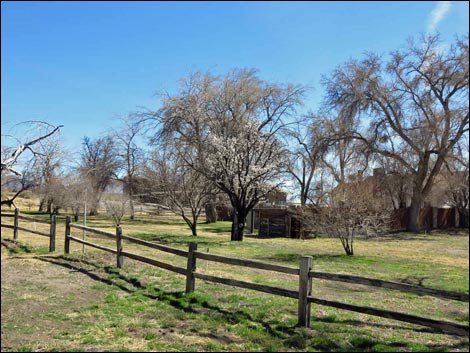 Orchard during winter (view SE) |
Just past the bridge over the inlet stream, the trail forks. The Coyote Trail turns left, while the short Roadrunner Trail and longer Bighorn Trail turn right. Staying left on the Coyote Trail, the trail runs along the edge of the cement pond. A bench provides birders with a place to sit and watch birds come in for water. Keep an eye out for waders and shorebirds, and then lots of Mourning Doves in the evening. Beyond the cement pond, the Coyote Trail forks, and here the Coyote Trail becomes a loop. Birders can walk in either direction, but I usually continue straight down along the stream. West of the cement pond, look for birds in the grass and on the wooden fence along the orchard. Grassy areas are good for sparrows and other ground birds, and the trees and fence posts provide perches for flycatchers. When fruiting in the spring, the Mulberry trees around the orchard can have huge numbers of birds gorging on the ripening fruits. This area is where we most often see Lazuli Buntings, Blue Grosbeaks, woodpeckers, and Lucy's Warblers. |
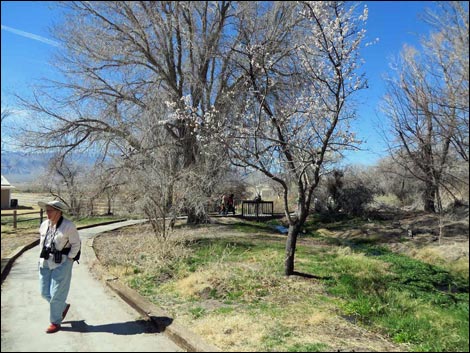 Birder at the lower end of the orchard during winter (view W) |
The old orchard provides habitat for songbirds, flycatchers, and woodpeckers. The shrubs at the west end of the orchard often hide something interesting (e.g., Brown Thrasher, White-crowned Sparrow). Shrubs and trees on the edge of the orchard often are productive, as many birds drink and bath in the stream. Watch for frogs and toads in the stream, too. Just beyond the orchard, there is a brief view of the new wetlands. Historically this area has been good for Western Kingbirds and an assortment of other flycatchers (Eastern Kingbird). This is also a good area to look for "unusual" species such as Great Blue Herons, Great Egrets, White-Faced Ibis, Killdeer, Bobolink, and Wilson's Snipe. The trail then bends right and climbs onto the old dike that once held Ponds 2 and 3. The ponds are gone, but the trees that have grown in are good for all sorts of birds. Look for warblers; Hooded, Bullock's, and Scott's Orioles; flycatchers; Cedar Waxwings; and sparrows. Check the ground under the trees just south of the old ponds. Birders also get a few elevated places along this part of the trail to look back and scan the pasture for flycatchers and other perching birds. |
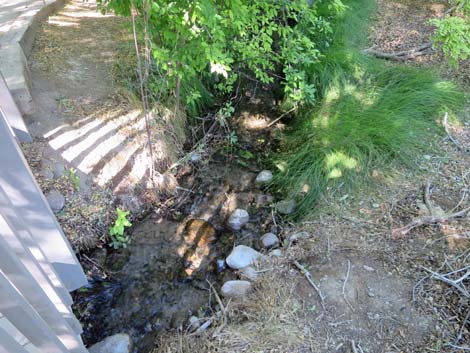 Stream along orchard (view E) |
The Coyote Trail goes over a bridge between Ponds 2 and 3, then forks: the Coyote Trail bends to the right along the edge of old Pond 2, while the trail to the left connects with a service road and runs down along the boneyard fence. Use the service road to connect with the west end of the Birdsong Trail. To the west, check the trees and shrubs along the chain-link fence around the maintenance yard (the "boneyard") for sparrows, finches, thrashers, and tanagers. Sunflowers along the fence often are full of Lesser Goldfinches and sparrows. From the west end of boneyard, scan the Honey Mesquite and Cottonwood Trees to the north, then walk back up the road along the north side of the boneyard towards the main trail. The desert shrubs north of the road usually have interesting birds, so watch for Crissal Thrashers, Blue-gray Gnatcatchers, Verdin, Phainopepla, and other desert species. Consider wandering up the Birdsong Trail for a closer look. |
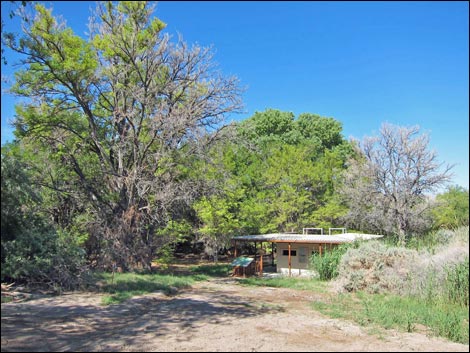 Pahrump Poolfish refugium |
Continuing on the Coyote Trail, stop and visit the poolfish house. The Fish and Wildlife Service built this refuge habitat in 2005 where they keep a remnant population of the endangered Pahrump Poolfish. Native fish are having a hard time throughout the Southwestern U.S. deserts as springs, creeks, and ponds dry up from overuse and drought. Read the information boards to learn of their plight. Continuing east, the trail passes a short spur to the restored Railroad Tie Cabin. Take a look inside the Railroad Tie Cabin and imagine what it was like to live here some 100 years ago. From the Railroad Tie Cabin, consider walking back west on the service road some 50 yards to the east end of the Birdsong Trail, as this is a good chance to carefully check the mesquite thicket for birds. Back at the Railroad Tie Cabin, continue on the Coyote Trail. This area, just before going over the low hill is good for Lucy's Warbler. The trail passes the other end of the Bighorn Trail, then arrives back at the start of the Coyote Trail loop near the corner of the cement pond. |
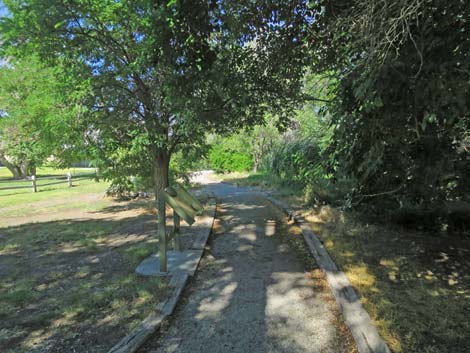 Trail between the orchard and the stream (view W) |
Follow the trail left (east) and circle around the cement pond. Approaching the visitor center, birders encounter a trail junction just before the footbridge over a creek. Turn left onto the Roadrunner Trail and follow the creek upstream for about 100 yards to look for the two springs that provide water for the area (but they usually are completely overgrown). This Roadrunner Trail turns right onto a bridge over the stream and returns to the Visitor Center, while the Bighorn Loop Trail runs out into the desert scrub, but it gets away from the better birding areas but provides an unobstructed view of the sky: watch for hawks, swallows, and drone aircraft. Return to the visitor center, and when leaving area, be sure to re-check the saltbush flats for Horned Larks, desert sparrows, and Le Conte's Thrashers. |
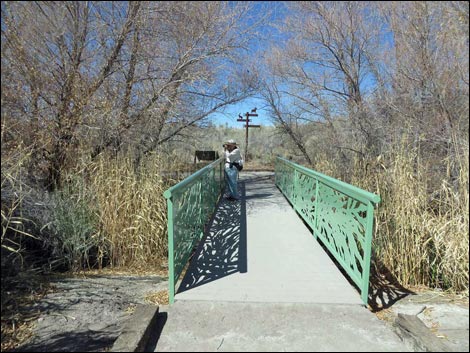 Bridge over stream on Roadrunner Trail during winter (view N) |
Specialties Of all the places to go birding around Las Vegas, this historically was the best place for finding desert species, seasonal migrants, and unusual migrants -- this is where the birds showed up. Watch for desert residents and seasonal migrants. Corn Creek is a bird magnet. Everything eventually shows up here. During spring and summer, watch for Phainopepla, desert warblers, desert sparrows, thrashers, and hummingbirds; and during fall, watch for migrants and eastern warblers. This site is also good for falcons, accipiters, flycatchers, orioles, tanagers, grosbeaks, and buntings. Keep an open mind and look for unexpected species such as Zone-tailed Hawks, Hooded Warblers, and Harris' Sparrows. Winter generally is quiet, but there is always something flitting about. |
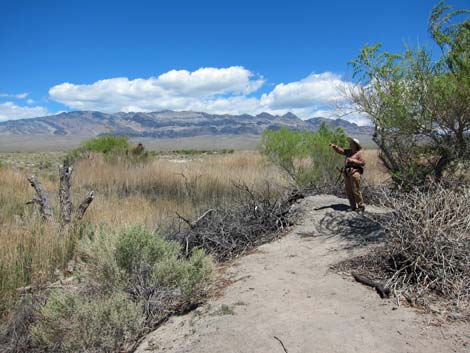 Highpoint on the Birdsong Trail (view E) |
Watch for other wildlife too. During warmer weather, watch for large Yellow-backed Spiny Lizards on tree trunks and on the railroad-tie cabin, and watch for Side-blotched Lizards and Western Whiptail Lizards on the ground. Watch for Bullfrogs and crayfish in the stream. Black-tailed Jackrabbits, Desert Cottontail Rabbits, Coyotes, White-tailed Antelope Squirrels, pocket gophers, and several other species of rodents are common here. Be sure to visit the poolfish refuge and learn of their plight. During warm weather, keep an eye out for desert tortoise and snakes. |
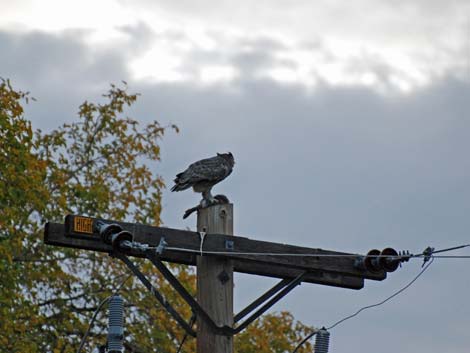 Birding at dusk can be rewarding |
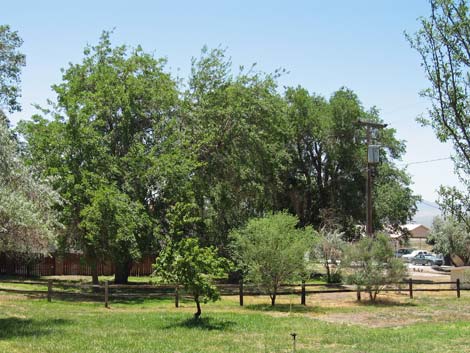 Mulberry trees and orchard in summer |
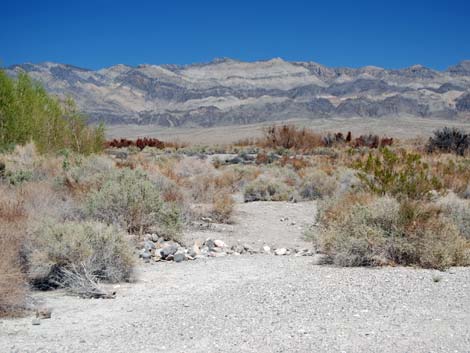 Mojave Desert Scrub and mesquite-sand dune woodlands (view E) |
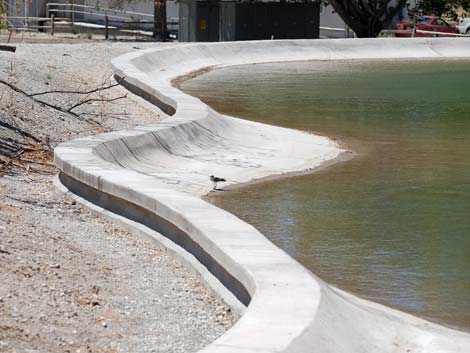 Life begins to return: Killdeer at the cement pond |
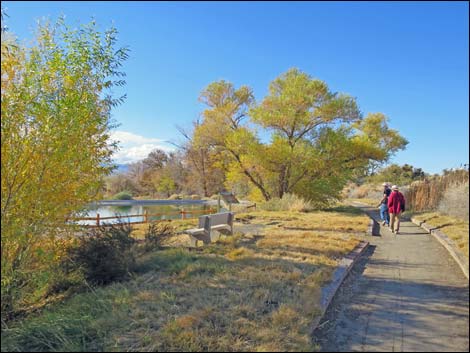 Fall colors |
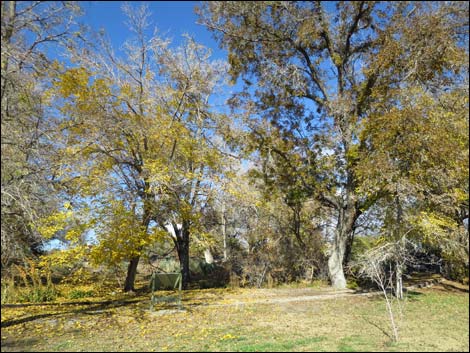 Fall colors |
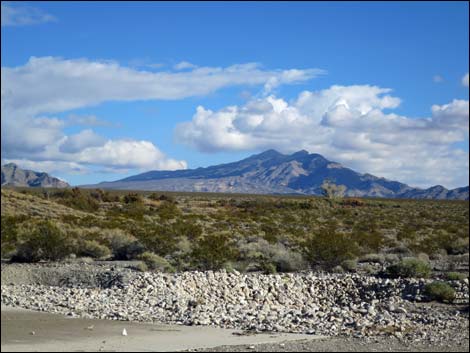 Gass Peak in the distance (view SE) |
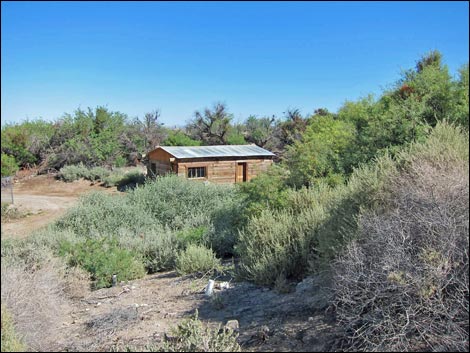 Mesquite thickets by the railroad-tie cabin (view N) |
Happy birding! All distances, elevations, and other facts are approximate.
 ; Last updated 240322
| Birding DNWR | Birding Around Las Vegas | So. NV Birds | Guide Service | Copyright, Conditions, Disclaimer | Home |